
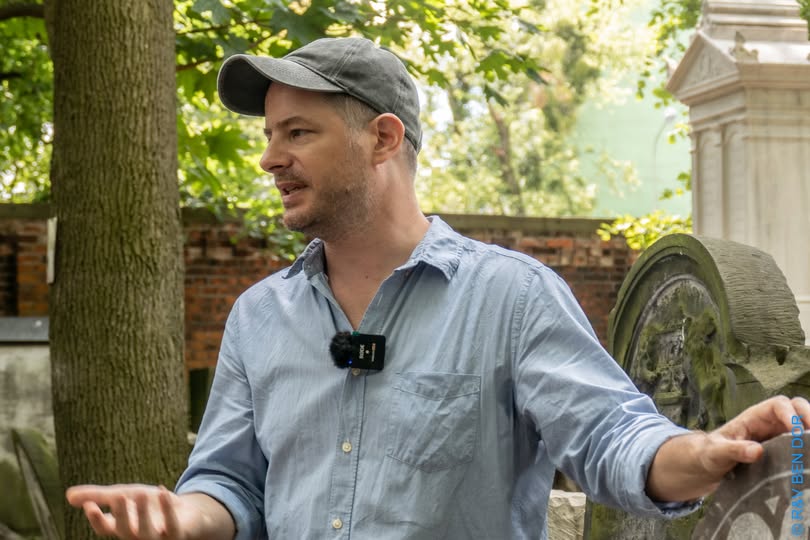
WARSAW, Poland (VINnews) — The longtime director of Warsaw’s largest Jewish cemetery has been dismissed following a disagreement over who should have decision-making authority in efforts to preserve one of Europe’s most significant Jewish burial sites, according to reporting by the Jewish Telegraphic Agency.
Join our WhatsApp groupSubscribe to our Daily Roundup Email
Witold Wrzosinski, a member of Warsaw’s Jewish community who had overseen operations at the Okopowa Street Jewish Cemetery, said he was removed from his post after objecting to arrangements that he said sidelined local Jewish voices from restoration and conservation decisions.
The cemetery, established in the early 19th century, contains the graves of roughly 200,000 people, including generations of rabbis, writers and community leaders, as well as mass burial sites for Jews murdered during the Nazi occupation. Parts of the cemetery remain in use by Warsaw’s current Jewish population.
According to JTA, the dispute centers on the role of a government-linked cultural body that manages public funds allocated for restoration projects at the site. While the local Jewish community is responsible for daily operations, major preservation initiatives depend on state-administered funding.
Wrzosinski said the current framework gives the funding authority broad control over project priorities, leaving the Jewish community with limited influence over work carried out in its own cemetery. He has argued that such an arrangement undermines both religious considerations and communal responsibility.
The cultural body overseeing the funds is headed by an official with connections to Poland’s former conservative government, which critics have accused of promoting a narrow interpretation of wartime history that minimizes discussion of Polish antisemitism. The foundation did not respond to JTA’s requests for comment.
Public investment in the cemetery increased significantly after the Polish government committed tens of millions of dollars toward restoration several years ago. Wrzosinski said the agreement was initially welcomed as an opportunity to rescue the neglected site, but later raised concerns as control consolidated outside the Jewish community.
After Wrzosinski pushed for changes that would formalize Jewish oversight, he said funding was threatened and legal action was raised as a possibility. Members of the local Jewish governing board later voted to remove him from his position.
His dismissal prompted criticism from historians, curators and Jewish heritage professionals in Poland and abroad, who warned that political considerations could interfere with the preservation of Jewish historical sites.
A petition circulated by senior figures in Jewish cultural institutions called for his reinstatement, arguing that safeguarding Jewish heritage requires leadership with deep communal knowledge and historical expertise.
Wrzosinski has worked at the cemetery for nearly two decades and has been involved in efforts to clean, catalog and digitize graves, helping descendants around the world locate family burial sites. He has said that several of his own relatives are buried there.
The controversy has renewed broader debate in Poland over who controls the narrative and stewardship of the country’s Jewish past — and how memory, politics and preservation intersect.
Poland still hasnt changed? Still trying to control us yidden even after death!
A frum bochur