
By Rabbi Yair Hoffman
Join our WhatsApp groupSubscribe to our Daily Roundup Email
The Storm Is Coming
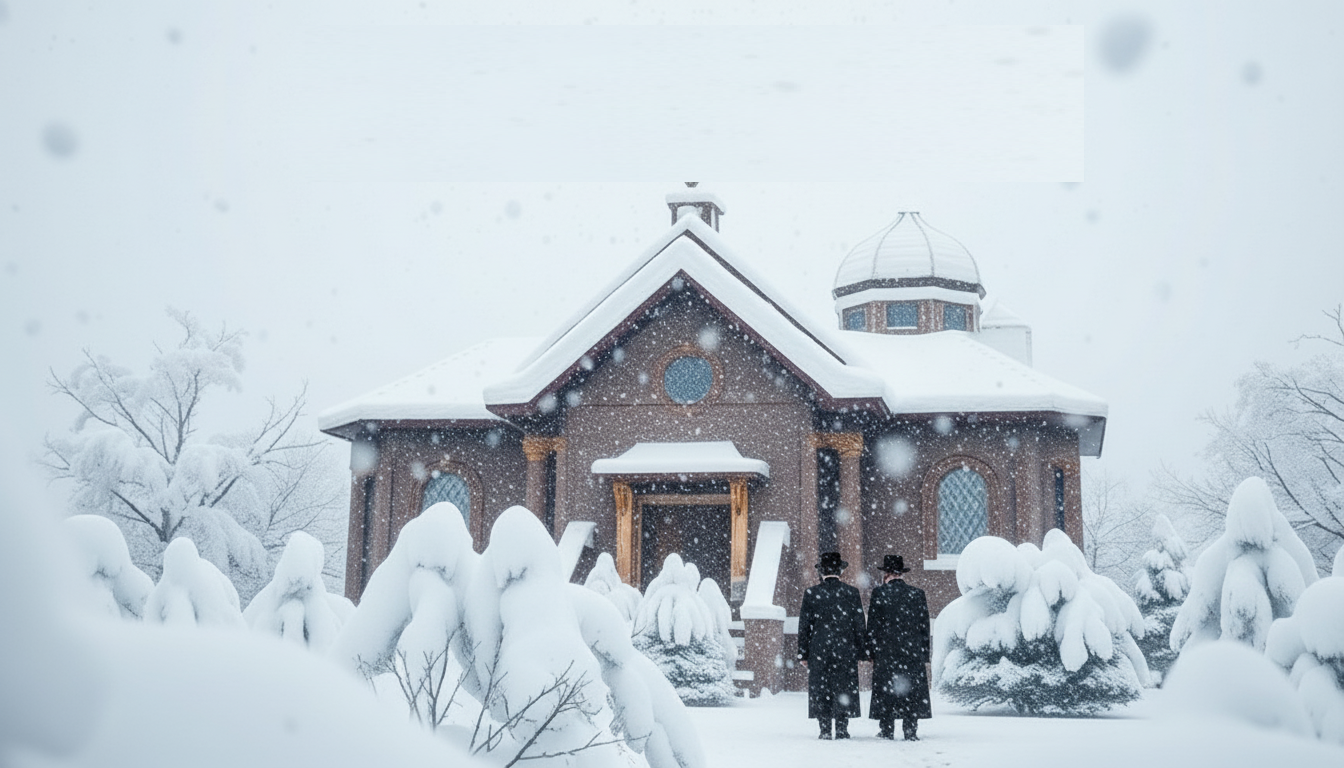
Forecasters are predicting up to 8 inches of snow for the New York metro area—and it’s arriving on Shabbos. Snow is expected to begin falling Friday evening around 6 p.m., with the heaviest accumulation between midnight and 6 a.m. Shabbos morning. If the forecast holds, this could be NYC’s biggest snowfall in nearly four years.
Because most of this storm will hit during Shabbos, everyone needs to do everything possible to prepare before Shabbos—or risk facing a complex halachic situation when the snow piles up.
The Wonder of Snow
Before we explore the halachos, let’s pause to appreciate what snow actually is—because understanding its nature deepens our awe of Niflaos HaBorei.
Snow is far more intricate than frozen rain. It begins as water vapor—individual molecules of H₂O suspended invisibly in the atmosphere. When temperatures drop below freezing, these molecules skip the liquid phase entirely and crystallize directly from vapor into solid ice. This process is called “deposition.” Water is one of the only common substances on Earth that regularly exists and transitions between three phases—solid, liquid, and gas—under natural atmospheric conditions.
How a Snowflake Is Born
A snowflake begins around a microscopic nucleus—often a dust particle, salt crystal, or pollen grain—floating high in a cloud. Water vapor molecules attach themselves to this nucleus and lock into a hexagonal (six-sided) crystal lattice. Growth continues outward, branch by branch.
Why six sides? Because of the quantum-level geometry of the water molecule itself: two hydrogen atoms, one oxygen atom, bonded at a precise angle of approximately 104.5°. This angle forces ice into hexagonal symmetry. Every snowflake, no matter how wild or ornate, obeys a molecular command built into the bri’ah—physics reflecting the precision of the Creator.
“No Two Snowflakes Are Alike”
Is this true? Yes and no. Structurally, all snowflakes follow the same hexagonal rules. But practically, the number of possible variations is so astronomically large that the chance of two identical snowflakes forming is effectively zero. Each snowflake passes through slightly different temperatures, encounters different humidity levels, rotates differently as it falls, and grows branches at different moments. A change of one-tenth of a degree alters the entire growth pattern. Billions upon billions of snowflakes fall—each shaped by a unique, unrepeatable journey through the sky.
Snow Is Transparent—Yet Appears White
Individual snowflakes are actually transparent. Snow appears white because light enters the ice crystals, scatters in all directions, and all wavelengths reflect equally. White is total reflection.
Chazal describe white as the color of taharah, cleansing, and forgiveness. Yeshayahu HaNavi declares: “Im yihyu chata’eichem kashanim, kasheleg yalbinu”—”Though your sins are scarlet, they shall become white like snow.”
Snow is life-sustaining. It traps air, making it a superb insulator—crops, seeds, and soil are protected from lethal cold beneath a blanket of snow. Mountain snowpack acts as a natural reservoir, slowly releasing water in spring and summer long after the storm has passed. Snow’s high reflectivity helps regulate Earth’s temperature, preventing runaway warming. If snow behaved even slightly differently, rivers would flood unpredictably, agriculture would collapse, and ecosystems would destabilize. Snow falls softly—but it holds the planet together.
The Precision Required for Snow to Exist
Consider how narrow the margins are: if Earth were slightly warmer, we’d have only rain; slightly colder, permanent ice. Different atmospheric pressure would prevent crystals from forming. Different molecular geometry would eliminate the hexagons. Different gravity would prevent the gentle descent. Snow exists only because Hashem has perfectly aligned and orchestrated dozens of independent variables.
When we say “Mah rabu ma’asecha Hashem”—”How abundant are Your works, Hashem”—we are saying that water obeys invisible laws written into reality, that each snowflake follows rules more precise than any human engineer could design, that infinity expresses itself in the smallest crystal, that beauty and utility coexist without conflict, and that order can appear gentle, silent, and falling from the sky. Snow does not shout. It whispers. And in that whisper is the kol demamah dakah of creation itself.
Preparing Before Shabbos
The best way to handle snow on Shabbos is to prevent the problem before it starts. Pre-salt and pre-sand your walkways on Friday. This can help prevent ice from bonding to the surface and make any snow that does accumulate easier to manage after Shabbos.
Equally important: set aside your salt and sand specifically for Shabbos use. This designation ensures the materials won’t be considered muktza, allowing you to use them on Shabbos if necessary.
Practical Guide: What to Do on Shabbos
What happens if you prepared before Shabbos, but the snowfall turns out to be significant and creates a hazard anyway? Here’s what you need to know.
Salting and Sanding
You may spread salt or sand on snow or ice on Shabbos. Do it by hand—not with a mechanical spreader. Halachically, sanding is preferred because salting more directly causes the snow to melt, changing its form. Nevertheless, salting is permitted when necessary, and certainly when there’s concern that someone might slip and fall.
For those who permit salting ice on Shabbos, commercial ice-melt salt is considered a kli shemelachto l’heter—an object whose primary use is permitted (similar to ashes set aside for permitted purposes; see Shulchan Aruch OC 308:38). For those who are stricter about salting, such salt would be muktza—but even they agree it’s permitted when there’s a safety hazard.
Shoveling Snow
If you can walk through the snow safely, leave it alone. But if the snow presents a genuine hazard and hasn’t yet hardened, you may sweep or shovel to maintain a minimal path in and out of your home. This leniency applies for safety reasons and for the sake of a mitzvah—such as being able to attend tefillah b’tzibbur.
Critical limitations: This allowance covers only the minimum necessary pathway. Shoveling your entire driveway just to make things easier after Shabbos is not included. Additionally, this only applies to paved surfaces like concrete and brick. Shoveling snow off dirt or grass is prohibited because you might smooth the ground (ashvuyei gumos, part of the melacha of choreish) or clip the grass.
Rav Tzvi Pesach Frank (Har Tzvi, Tal Oros, Soseir no. 1) made an important distinction between soft and hardened snow. If snow has frozen and become attached to the surface, removing it might involve the melacha of soseir (demolishing). There’s more room for leniency with freshly fallen soft snow than with ice that has bonded to the sidewalk.
Some authorities permit walking on a snowy sidewalk and kicking the snow aside with your foot as you go, while others prohibit even this (see Shulchan Aruch OC 316:11 and Mishnah Berurah 316:51). If salting alone isn’t sufficient, sweeping snow aside with a broom may be a halachically preferable alternative to shoveling.
Hiring a Non-Jew
A Jew may not hire a non-Jew to perform work specifically on Shabbos. However, if the non-Jew is paid a flat fee for the entire winter season—to shovel whenever necessary, not just this Shabbos—then it’s permitted to allow him to shovel snow by hand.
If you didn’t arrange this before Shabbos, you may still ask a non-Jew to shovel on Shabbos itself, but you may not discuss payment until after Shabbos (Shulchan Aruch OC 306:6).
Having a non-Jew salt the ice is the preferred option when there’s a public hazard. Rav Shlomo Zalman Auerbach zt”l defined “public” for these purposes as any group of three or more people—this could even be limited to members of your own household who need to use the walkway. When a genuine public hazard exists, the Sages did not apply their various safeguards to the sanctity of Shabbos (Shulchan Aruch OC 308:18).
Snow Blowers and Plows: Absolutely Not
Equipment powered by gas or electric engines—snow blowers, machine-shovels, or snow trucks—involves Biblical-level melacha. A non-Jew should not use such equipment on your behalf, on your property, on Shabbos. If you have a snow removal arrangement, instruct them accordingly.
Rav Asher Bush (Beis Yitzchak no. 40, 2008) explains that while manual shoveling involves only rabbinic prohibitions, operating a snow blower involves Biblical prohibitions. Having a non-Jew use one means he’s committing a Biblical violation on your behalf, publicly, on your property, and with your permission.
The only possible exception: if a shul can only find someone who will use a snow blower and this is the only way to prevent davening from being cancelled, it might be permitted as a public mitzvah need.
What About the Shovels Themselves?
For those who permit shoveling when necessary, a snow shovel is classified as a kli shemelachto l’heter and is not muktza. A regular shovel—designed for digging dirt—is a kli shemelachto l’issur. However, such utensils may be handled for a permitted purpose (just as you may use a hammer to crack walnuts), so a regular shovel may be used if a snow shovel isn’t available.
Now that we’ve covered the practical applications, let’s explore the underlying halachic principles in greater depth.
Is Snow Muktza?
Generally, something that comes into existence on Shabbos is considered nolad (newly created) and may not be moved. However, the Gemara in Eiruvin (45b-46a) teaches that rain is not nolad because the moisture already existed in the clouds. Based on this, Tosafos (Beitzah 2a) and many authorities extend this leniency to snow.
This is the position of numerous Acharonim including the Chavos Yair, Even HaOzer, Maamar Mordechai, and the Butchatcher Rav. Contemporary poskim who concur include Rav Tzvi Pesach Frank, Rav Shlomo Zalman Auerbach, Rav Yosef Shalom Elyashiv, the Debreciner Rav (Be’er Moshe 1:20), the She’arim Metzuyanim B’Halacha, Rav Ovadia Yosef, Rav Chaim Kanievsky, the Rivevos Efraim, the Nishmas Shabbos, Rav Pesach Eliyahu Falk, and the Shemiras Shabbos Kehilchasah (ch. 16, n. 110).
For snow to be permitted, it must be “clean”—once melted, it should be fit for a person to wash with or for an animal to drink (Mishnah Berurah 338:30).
Rav Moshe Feinstein’s dissenting view: Rav Moshe zt”l held that snow is muktza for two reasons. First, unlike earlier generations who melted snow for water, we have no practical use for it—making it similar to gravel or stones (see Rabbi Bodner’s the Halachos of Muktza, p. 165, n. 10). Second, he considered snow that falls on Shabbos to be nolad because people don’t perceive snow as existing in the clouds beforehand the way they do with rain (Igros Moshe OC Vol. V 22:37).
Melting Snow and Ice
The Shulchan Aruch (OC 320:9) rules that melting ice and snow passively is permitted, but doing so actively is prohibited. You may not squeeze or crush snow or ice to extract water—this is called risuk and is a derivative of s’chitah, the melacha of extracting juice from fruit (OC 320:11). However, if snow melts on its own, the resulting water may be used.
Why Is Shoveling Generally Prohibited?
Even if snow isn’t muktza, shoveling it on Shabbos is generally prohibited for several reasons:
Tircha (Excessive Exertion): The Mishnah (Shabbos 126b) prohibits moving large objects on Shabbos because of the physical effort involved. Rav Avraham Weinfeld (Responsa Lev Avraham no. 49) applies this to shoveling snow (see Mishnah Berurah 333:1).
Uvda D’chol (Weekday Activity): Shoveling is associated with the work during the week and is therefore inappropriate for Shabbos (Shulchan Aruch OC 333; Mishnah Berurah 333:1).
Zilusa D’Shabsah (Degrading Shabbos): Some activities, even if not technically forbidden, are considered disrespectful to the spirit of Shabbos (Igros Moshe OC 4:60).
The Issue of Carrying
All the leniencies discussed assume you’re in an area with a valid eruv. Without an eruv, moving snow involves hotza’ah (carrying). In a true D’oraisah reshus harabim, carrying is prohibited under all circumstances.
Rav Menasheh Klein (Mishneh Halachos vol. 5, no. 4) discusses shoveling to prevent falls in areas where carrying is only rabbinically prohibited. He is hesitant to permit it because people often walk on snow, making it hard to determine when it’s truly dangerous. He concludes that hiring a non-Jew is preferable.
Many homeowners sign seasonal contracts to have their driveways plowed whenever snow accumulates. But if snow falls on Shabbos and triggers the contract, isn’t that like commanding the non-Jew to plow on Shabbos—violating amirah l’akum?
Several arguments have been proposed for leniency: the contract doesn’t explicitly mention Shabbos; there’s a permissible alternative (manual shoveling); and the non-Jew chooses his own method. Some Poskim hold that none of these arguments are strong enough to rely upon definitively.
The solution: It is permitted to sign a seasonal contract if you clearly stipulate that you do not want your driveway plowed on Shabbos. With this condition, even if the non-Jew shows up on Shabbos anyway, there’s no violation of amirah l’akum.
Some suggest that even stipulated contracts should be discouraged because of zilzul Shabbos—the Rama prohibits noisy machines on Jewish property on Shabbos lest neighbors suspect the Jew of operating them. However, when a truck is clearly being driven by a non-Jew, this concern doesn’t apply.
Making Snowballs on Shabbos
Can you make snowballs on Shabbos? This question is far more complex than it seems, and the poskim discuss several potential prohibitions without reaching consensus on the primary concern.
Carrying (Hotza’ah)
One thing is clear: without an eruv, outdoor snowball fights are forbidden because throwing snowballs transgresses hotza’ah. Everything below assumes a valid eruv.
Building (Boneh)
Many authorities prohibit making snowballs because of boneh (building). The Rambam, cited by the Mishnah Berurah (320:36), rules that joining separate parts to form a new item is “similar to building.” The Chavos Yair (writing in the 1690s!), Rav Shlomo Zalman Auerbach, and Rav Chaim Kanievsky apply this to snowballs.
However, Rav Moshe Feinstein, the Debreciner Rav, and the Nishmas Shabbos disagree—boneh requires at least minimal permanence, and a snowball that exists for mere seconds doesn’t qualify. (They agree that building a snowman—meant to last days—would be prohibited.)
Crushing/Squeezing (Risuk)
Another concern is risuk (crushing). When you compress snow into a ball, you inevitably crush some of it, causing slight melting. Scientifically, this is called “regelation”—compression causes a melt, then releasing pressure causes refreezing. This is what holds a snowball together.
Interestingly, the scientist who discovered regelation, Michael Faraday, was born about 100 years after the Chavos Yair first discussed these halachic implications of snowball-making.
The Chavos Yair and Debreciner Rav cite risuk as grounds for prohibition. Rav Moshe Feinstein and the Nishmas Shabbos counter that any melting while forming a snowball outdoors in freezing temperatures is too minuscule to constitute prohibited squeezing.
Other Potential Issues
Various other prohibitions have been discussed: me’amer (gathering the snow); uvda d’chol (weekday activity); and soseir (destroying—when the snowball shatters on impact).
The Bottom Line
Although some poskim permit young children to make snowballs, the majority rule it’s prohibited. The Chavos Yair instructed that if one sees children throwing snowballs on Shabbos, one should stop them. (His full commentary was only re-published in 1982, and identified by Rav Ovadiah Yoseph – even though it was written in the 1690s!)
While the poskim don’t agree on the exact reason, the consensus (hachra’as haposkim) is that making snowballs—and certainly building snowmen—is forbidden on Shabbos.
Civic Responsibility
Beyond the halachic considerations, there’s a civic and moral obligation to clear your sidewalk from snow and ice—before and after Shabbos. Leaving sidewalks hazardous endangers everyone who needs to use them and forces pedestrians into the street, creating additional dangers.
This responsibility is especially important on blocks around shuls, where foot traffic is heavy. Contributing to safe walkways is a genuine act of chesed for your neighbors and community.
Conclusion
A snowstorm is cosmic choreography, played out molecule by molecule. To the scientist, snow is a triumph of physics. To the Torah Jew, physics itself becomes testimony.
When snow falls, the correct response is wonder—and praise: Ma Rabu Maasecha Hashem!
Snow on Shabbos requires both advance preparation and knowledge of the halachos. Pre-salt and pre-sand before Shabbos, and designate materials for Shabbos use. If a hazard develops on Shabbos, you may salt or sand by hand, and if necessary, clear a minimal pathway on paved surfaces. A non-Jew may shovel manually (not with powered equipment) if paid for the season or if payment is deferred until after Shabbos. Seasonal contracts should explicitly exclude Shabbos. Making snowballs and building snowmen are prohibited according to most authorities.
As with all halachic matters, consult your rav for guidance tailored to your specific situation.
The author can be reached at [email protected]
Nice article. Thanks!
Thank you, Rabbi.
Also important to be sure to shake snow off of hat and winter coat LIGHTLY (first Biur Halacha-Shin Beis). A shaina coat may be more leinient, (ask you LOR)
Thank you and good shabbos. Very interesting and timely and the research is accurate so I know you are not snowing us