
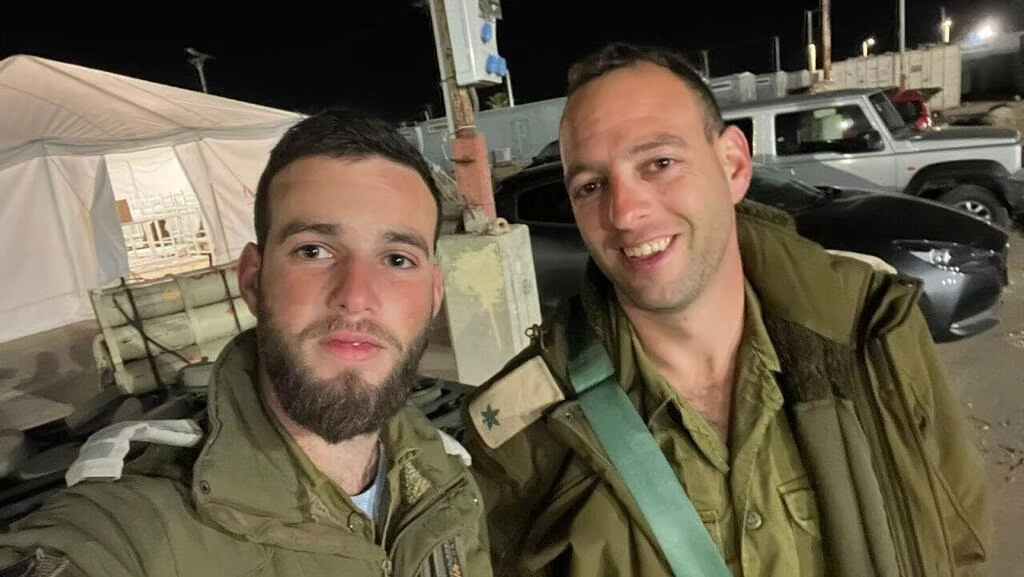
JERUSALEM (VINnews) — Maj. (res.) Dovi Yudkin, brother of Capt. Yisrael Yudkin HYD, a Netzach Yehuda soldier who was killed in combat in northern Gaza, spoke with Channel 7 after he attended a meeting on the charedi draft law in the Knesset’s Foreign Affairs and Defense Committee.
Join our WhatsApp groupSubscribe to our Daily Roundup Email
Yudkin explained why he opposes drafting charedim through legislation, and what he believes should be done to encourage charedi enlistment based on his own service.
“As someone who comes from a charedi home, has served in the army for 13 years, and as a bereaved brother, it was very important for me to come and speak in the Knesset,” Yudkin said at the start of the interview. “Unfortunately, the public discourse around conscription is very unhealthy, akin to the discourse of October 6 (prior to the war), and we must not return there. My message is that we need to be in an October 7 mode: a mode of brotherhood, doing this together, in unity and love of Israel, not out of hatred and division.”
According to him, “The conscription law should not come from the IDF. The army has no mandate to speak on this issue, and it’s even forbidden for it to do so because that would be a political statement. The IDF can say, ‘I’m short on fighters,’ and it’s the political echelon that must find solutions. If the chief of staff were to come to the government and say he needs more budget and therefore Arabs should pay taxes, he would immediately be attacked, because that would be a statement beyond what he’s allowed to say.
“Therefore, this whole issue of a conscription law cannot be, and should not be, enshrined in law. If someone had come to me 13 years ago and told me I was required by law to enlist, I probably wouldn’t have enlisted. I enlisted out of desire and motivation, and this whole approach (forcible conscription) only pushes charedim away. For every person who is arrested, there are a thousand who will never come, and that’s a great shame. Charedi society is highly contributive, and this process must be done through dialogue and embrace,” Yudkin explained.
He also argued that the army is not being truthful when it speaks about a shortage of fighters. “There isn’t even one lesson the IDF has admitted it got wrong and is correcting, but pointing a finger at the Haredi public is the easiest thing to do, because it diverts the fire. It’s shocking to see this. I presented the committee with a very organized table showing how, in the years before the war, reserve armored units were closed—six divisions, three corps—astronomical numbers of soldiers who still haven’t been called up. The IDF doesn’t lack soldiers, it lacks management.”
Another problem Yudkin raised is that, to date, the IDF has not anchored even a single order safeguarding the needs of charedi soldiers. “If tomorrow a charedi soldier doesn’t receive the level of kosher food he requires, he has no one to turn to and no one to file a complaint with. There is no order that anchors this. That’s why this is all political theater. Just like with the Alice Miller High Court ruling in the 1990s, the IDF had to change all the regulations and bases, and for years it drafted orders integrating women.”
In his view, “The army needs to show willingness. That’s why it was important for me to come to the Knesset and say: let’s return to love of Israel, to unconditional love. You can see processes already moving within charedi society.”
Yudkin cited the example of charedi women entering the workforce, which today exceeds participation in the general population. “They built incentives, established appropriate institutions, and brought about change in the country,” he explained.
He added: “We are a charedi family from Kfar Chabad with four children who serve. Sit down with my mother, understand the gaps, try to understand how charedi society works. In the current format, you can’t bring in the masses. The army is not fit, not prepared. Still, when I enlisted there were four soldiers from Kfar Chabad, and today a third of the residents have enlisted. It’s a process; you can’t change it in a single day. My brothers chose to enlist out of choice and desire.
“Over the years there were things that harmed our way of life. When I went to the officers’ course at Bahad 1, I was made to sign a waiver of Netzah Yehuda conditions. We saw women, ate food that was less strictly kosher, and our way of life was affected. That shows the army is still not ready for mass absorption of charedi soldiers. Adaptations, outreach, and proper messaging will be required, these things must change.”
Asked what he believes the solution is, Yudkin answered: “Anyone who doesn’t enlist, whether Haredi, Arab, or anyone else, should face economic sanctions, because ultimately everyone needs to serve. At the same time, the charedi sector should receive incentive scholarships to give the push. Within a few years we’ll see change. In charedi society, everyone understands and wants to contribute, and if the IDF implements the right process, the charedim will come.”
the IDF goal is not soldiers its to make all chilonim, thats why they dont drafy Israeli Arabs since they know they cant make them abandon Islami, IDF is not drafting all the partying tel aviv elite likewise BIbi’s 2 able bodied sons. they want to make frum frei.