
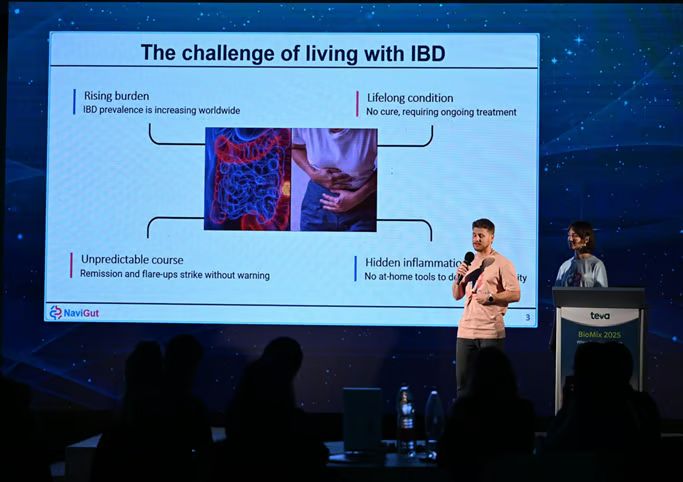
REHOVOT, ISRAEL (VINnews)— New technologies developed by Israeli researchers may enable early detection of flare-ups in inflammatory bowel disease before symptoms emerge, potentially transforming treatment for millions of patients worldwide.
Join our WhatsApp groupSubscribe to our Daily Roundup Email
Inflammatory bowel disease, encompassing Crohn’s disease and ulcerative colitis, impacts more than 10 million people globally. The chronic illnesses are marked by unpredictable flare-ups that can lead to intense pain, hospitalizations and lasting intestinal damage.
Despite advances in treatments, physicians still lack straightforward, noninvasive tools to monitor disease activity continuously and predict impending flares.
Two innovative Israeli projects aim to address this by providing advance warnings to patients and doctors.
One technology, developed by Nachi Natan, a Ph.D. candidate at the Weizmann Institute of Science, involves genetically engineered bacteria that sense gut inflammation. Upon detecting inflammatory signals, the bacteria generate a detectable marker in urine, allowing identification of rising activity before symptoms occur and enabling timely intervention.
Natans project, dubbed Navigut, uses synthetic biology and recently gained recognition at BioMix 2025, an innovation program backed by Teva Pharmaceuticals.
The second approach comes from Ofir Bar, a cancer researcher and Ph.D. candidate, who created Wellnitor — a wearable skin patch that tracks physiological signs of stress, a known trigger for flares.
Studies indicate patients experiencing high stress have up to 3.6 times greater risk of flare-ups. The patch monitors stress markers along with inflammation indicators in real time, with artificial intelligence analyzing the data to issue alerts about escalating risks.
Combined, the technologies could offer a comprehensive view of both inflammation and stress triggers, shifting IBD management from reactive to preventive.
Earlier detection may reduce hospitalizations, limit complications and allow more personalized care, researchers said. While not a cure, the tools could provide patients greater control over an often unpredictable condition.
“The young minds of Israeli academia … continue to prove that innovation does not stop,” said Yossi Bar-On of Teva, highlighting initiatives addressing unmet needs in medicine.