
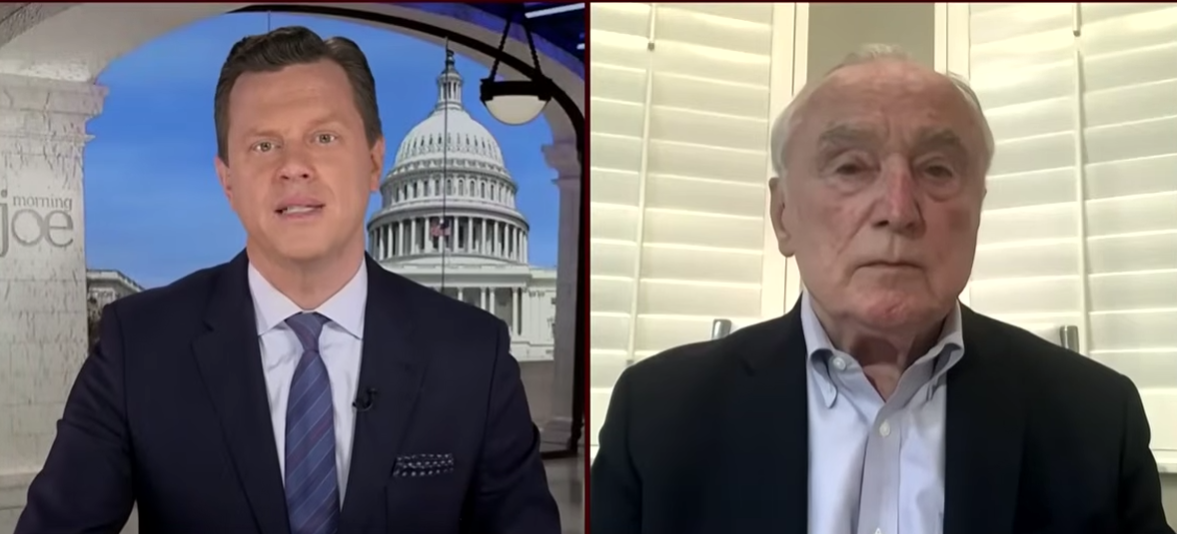
NEW YORK — Former New York City Police Commissioner Bill Bratton sharply criticized comments by Vice President JD Vance about the fatal shooting of a Minneapolis woman by an ICE agent, calling the remarks “inappropriate and uncalled for” and warning that political leaders are rushing to judgment before investigators have established the facts.
Join our WhatsApp groupSubscribe to our Daily Roundup Email
In an interview Thursday on MSNOW Morning Joe, Bratton said statements suggesting the woman, 37-year-old Renee Nicole Good, was responsible for her own death only inflame tensions and undermine public trust in the investigation.
“This situation is already a mess — and it’s going to get messier,” Bratton said. “Instead of trying to de-escalate tensions, these comments only serve to inflame them.”
Vance said earlier this week that Good’s death was “a tragedy of her own making,” and suggested the ICE officer involved may have been acting with heightened sensitivity because he had previously been injured in a separate incident involving a fleeing driver.
Bratton, who spent more than five decades in law enforcement and led police departments in New York City, Los Angeles and Boston, said such conclusions are being drawn far too quickly — and dangerously so.
“We’ve spent the last 50 years in American law enforcement learning how to de-escalate these situations, not accelerate them,” he said. “What’s happening here runs counter to everything we’ve worked toward.”
Concern over investigation
Bratton also questioned the federal government’s decision to have the FBI take sole control of the investigation, warning that it could further erode confidence if the public believes the outcome has already been decided.
“When you already have the president, the vice president and senior Homeland Security officials effectively declaring who’s at fault, that raises serious concerns,” he said. “If the conclusion is already written, then it’s very hard for the public to trust the investigation.”
He argued that major use-of-force cases demand transparency and patience — not political declarations.
“The most important word in any police-involved shooting is ‘preliminary,’” Bratton said. “You tell the public what you know, you acknowledge what you don’t know, and you make clear the facts may change as the investigation continues.”
Bratton said he has reviewed the available video footage repeatedly but believes it raises more questions than answers.
“I’ve watched those videos dozens of times, and I’m still trying to understand exactly what happened,” he said. “Until you talk to the officers, talk to witnesses and analyze the footage frame by frame, you cannot draw conclusions.”
He added that the death of Good makes the search for clarity even harder.
“One of the key people who could explain what happened is no longer alive,” he said. “She can’t tell us what she was feeling, what she feared or why she was there. That leaves enormous uncertainty.”
Tactical questions
Bratton pointed to what he described as troubling tactical issues visible in the footage, including the positioning of agents around Good’s vehicle in the moments before the shooting.
“One agent is aggressively trying to open her door, yelling at her, while another moves in front of the vehicle,” Bratton said. “She may never have even seen that second agent because her focus was on the one at her door. That’s a serious tactical failure.”
He rejected claims that Good had accelerated aggressively toward officers, saying the speed and intent of her movements remain unclear and must be determined through a full investigation.
“This all happened in about a second,” he said. “Describing it now as if it were a high-speed attack is speculation, not fact.”
Broader strain between ICE and local police
Bratton also warned that the incident highlights growing strain between federal immigration enforcement and local law enforcement agencies across the country.
“There is real concern among police chiefs and sheriffs about the tension this is creating,” he said. “When things go wrong, it’s local police who have to clean it up — and who face the anger of the community.”
He said long-standing partnerships between federal and local agencies are being weakened by an enforcement approach that sidelines cooperation and imposes pressure through quotas and aggressive tactics.
“Law enforcement learned decades ago that quotas create bad outcomes,” Bratton said. “They distort priorities and increase the risk of mistakes.”
He added that pulling agents from agencies such as the FBI, DEA and ATF into large-scale immigration operations is also straining other critical missions, including counterterrorism, gun crime and drug trafficking.
“We’re weakening our federal agencies in one area to strengthen them in another,” he said. “At the same time, we’re damaging the relationships between federal and local law enforcement that took decades to build.”
Call for restraint
Bratton concluded by urging leaders to step back and allow investigators to do their work without political pressure.
“This needs to be recalibrated and refocused,” he said. “These are moments when restraint matters — from politicians, from law enforcement, from everyone.”
He added that restoring public trust must be the priority.
“You don’t win trust by rushing to judgment,” Bratton said. “You win it by being careful, transparent and fair — especially when a life has been lost.”
Nothing to talk about if the woman was blocking and harassing ice FEDERAL AGENTS and disobeyed orders from the agents she did it to herself!
They (Feds) need to listen to the man. He knows what he’s talking about!