

Join our WhatsApp group
Subscribe to our Daily Roundup Email
A New Charedi Revolution?
Rav Pini Dunner Speaks Out About Seminary Admissions, Dignity, and Change
BNEI BRAK (VINnews) — Several weeks after a shocking symbolic funeral procession stunned residents of Bnei Brak and sent shockwaves through the Charedi world, VINnews has learned that the unusual campaign was not the work of a fringe activist group, but was organized behind the scenes by HaRav Pini Dunner, the prominent Los Angeles Rav who is now calling for what he describes as a “new Charedi revolution.”
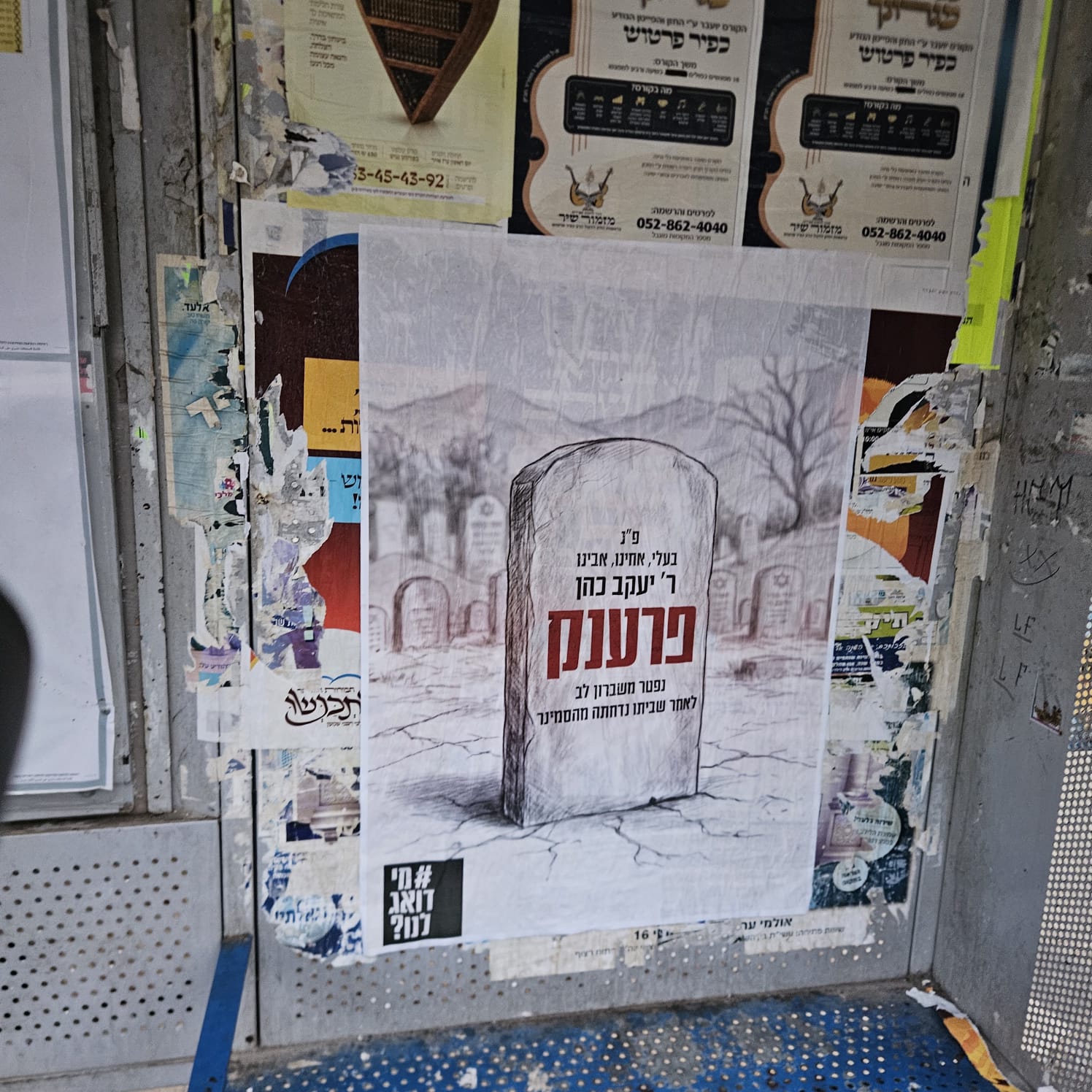
The protest, staged under the anonymous name Mi Yidag Lanu (“Who Will Worry For Us?”), featured a mock levayah for a fictional father said to have “died from heartbreak” after his daughter was repeatedly rejected from seminaries.
Participants carried a symbolic coffin through the streets of Bnei Brak, recited Tehillim, and distributed flyers highlighting what organizers described as years of humiliation experienced by families navigating Israel’s seminary admissions system.
One of the most striking images was a mock gravestone bearing the word “Frenk,” a term organizers said symbolizes the stigma and social labels that many Sephardic families believe continue to follow them within parts of the educational system.

The images spread rapidly throughout Israel, igniting fierce debate across Charedi neighborhoods, newspapers, WhatsApp groups, and social media platforms.
Supporters called the campaign painful but necessary.
Critics argued that the funeral imagery crossed a line.
Now, in an exclusive interview with VINnews, Rav Dunner says the controversy itself proves why the campaign was necessary.
“The levayah was fake. But the heartbreak is not fake. The tears are not fake. The girls sitting at home are not fake. The fathers who cannot sleep at night are not fake.”
A Campaign That Has Created A Storm Across Israel
While the campaign has received relatively little attention in the United States, in Israel it has become one of the most talked-about subjects in the Charedi community.
Over the past several weeks, thousands of families have engaged in discussions sparked by the campaign. Issues that were often discussed quietly behind closed doors are now being debated openly throughout the Charedi world.
Join the WhatsApp Group for Updates
This campaign is growing, and the conversation is no longer being whispered behind closed doors.
Join the WhatsApp group to stay informed, show support, and help bring attention to this issue.
According to Rav Dunner, that was precisely the objective.
“For years, people have whispered about this issue,” he said. “Everyone knows it exists, but no one wants to say it out loud. So we created something that could not be ignored.”
Although much of the public discussion has focused on Sephardic families, Rav Dunner insists the issue extends far beyond ethnicity.
“The issue is bigger than Sephardim versus Ashkenazim,” he told VINnews. “At its core, it is about whether every child in the Charedi community is treated with dignity and fairness.”
According to him, many working Charedi families, baalei teshuva, and others who do not fit a narrow social profile often encounter similar obstacles.
“This is about every family that feels unwanted because they don’t fit somebody’s ideal image.”
The Evidence Behind The Debate
The campaign comes amid renewed scrutiny of alleged discrimination in Charedi girls’ school admissions.
A major legal filing submitted to the Jerusalem District Court in January 2025 by Noar KaHalacha seeks certification of a class action lawsuit against the Jerusalem Municipality and three major Beit Yaakov seminary networks.
The petition alleges that elite seminaries have operated informal quotas limiting the admission of Sephardic and Mizrahi girls while presenting rejections as matters of educational standards, cultural fit, family background, or levels of religious observance.
The allegations have not yet been adjudicated in court.
The Jerusalem Municipality has disputed the petition’s characterization of the evidence and has argued that certain comments cited in the filing reflected the actions of an individual employee rather than official policy.
Nevertheless, the figures contained in the filing have attracted significant attention.
According to the petition, 539 girls were left without seminary placements for the 2024-2025 school year. Of those classified by ethnicity, 354 were Sephardic, 180 were Ashkenazic, and five were categorized as “half-half.”
Join the WhatsApp Group and Do Not Stay Silent
If these numbers trouble you, join the WhatsApp group to follow the campaign and help push for real change.
The filing also references an internal municipal database allegedly maintained for nearly two decades that classified applicants using ethnic identifiers such as “Beit Yosef” and “Rema” and included comments referencing “Ashkenazi mentality,” “Ashkenazi look,” and other descriptions that critics argue reveal discriminatory practices.
For Rav Dunner, those allegations represented a breaking point.
“When you see girls being discussed in terms of blood, look, mentality, and whether they are ‘too Sephardic,’ you cannot pretend this is just about standards. This is not chinuch. This is humiliation.”
A Problem That Has Surfaced For Decades

Rav Pini Dunner visits the Belzer Rebbe to give him the sefer he published, Ohr Hayoshor on Maseches Shabbos by Rav Shmuel Yitzchok Hillman with hagohos by Rav Dunner.
Rav Dunner argues that the current controversy is not based on isolated incidents.
The issue has repeatedly surfaced over the past two decades.
In the well-known Immanuel Beit Yaakov case, Israel’s Supreme Court ruled that separation between educational tracks constituted unlawful discrimination. The dispute eventually led to national headlines when parents refused to comply with court orders and some were jailed for contempt of court.
In Elad, authorities intervened after reports that all 25 Ashkenazic applicants to a seminary were accepted while only five of 93 Sephardic applicants gained admission.
Reports of large numbers of Sephardic girls remaining without school placements have continued to emerge in subsequent years.
“If this were a handful of isolated cases, we wouldn’t be discussing it,” Rav Dunner said. “But thousands of families face these challenges year after year.”
“This Is Not Anti-Charedi. It Is Pro-Charedi.”

Rav Pini Dunner meets with the Skvere Rebbe during the rebbe’s annual visit to California. Rav Dunner’s family has a very close relationship with Skver.
Despite the criticism directed at the campaign, Rav Dunner insists that his goal is not to attack the Charedi world but to strengthen it.
“I’m not against the Charedi community. On the contrary, I am part of it and proud of that.”
Raised in a Charedi family in London and educated in Charedi schools and yeshivos, Rav Dunner has spent decades supporting Torah institutions around the world and maintains close relationships with leading rabbinic figures across Israel and the Diaspora.
“This is not anti-Charedi. This is pro-Charedi. A community that humiliates its own daughters is damaging itself. These girls are our daughters. These fathers are our brothers.”
Join the WhatsApp Group to Help Enact Change
Meaningful change starts when people care enough to get involved. Join the WhatsApp group and be part of the solution.
He also rejects suggestions that discussing these issues constitutes an attack on rabbinic leadership.
“I am not fighting anyone, chas veshalom,” he said. “I believe that if many of our gedolim saw some of these situations firsthand, they would want to address them.”
Rav Dunner points to letters from Rav Elazar Shach opposing discrimination against Mizrahi students and directives attributed to Rav Yosef Shalom Elyashiv encouraging meaningful Sephardic representation within schools.
“People hide behind the name of Torah while doing something that Torah leaders themselves condemned,” he said.
A New Charedi Revolution
Beyond the admissions issue, Rav Dunner says the campaign reflects a broader conversation taking place throughout the Charedi world.
He describes a growing population of Charedim who remain deeply committed to Torah and Yiras Shamayim while seeking greater participation in Israeli society, whether through employment, national service frameworks, or broader civic engagement.
“The goal is not to weaken the Charedi community,” he said. “The goal is to make it stronger, fairer, and more faithful to its own ideals.”
Asked whether he regrets the dramatic imagery of the Bnei Brak levayah, Rav Dunner said he understands why some people were uncomfortable.
But he believes discomfort was necessary.
“If a regular letter would have worked, we would have sent a letter. If another quiet meeting would have worked, we would have had another quiet meeting.”
Then he returned to the question that inspired the campaign.
“How many fathers must die inside before someone listens? How many girls must be made to feel unwanted in their own community before we call it what it is?”
Whether the campaign ultimately leads to meaningful change remains to be seen.
But one thing is already clear: the conversation that Mi Yidag Lanu set out to create is no longer taking place in whispers.
And weeks after the symbolic levayah wound its way through the streets of Bnei Brak, its message continues to echo across the Charedi world:
The coffin was empty.
The pain was not.
Join the WhatsApp Group. Join the Campaign.
Receive updates, show support, and help enact meaningful change for families across the Charedi world.
He’s far from the first to call the discrimination against Sefardim out. Rav Shmuel Auerbach zt’l was front and center in the fight against this discrimination, and besides personally calling Mosdos to accept Sefardi students, he insisted any Mossad under his leadership had to accept a minimum 30% Sefardim (his own Yeshiva was a colorful mix of the ethnicities). But since you all look at him as a crazy Peleg radical, you would never print such a thing, or showcase all the good he did for Klal Yisroel. Instead, Rabbi Dunner is showcased as the leader in the fight (I wish him much Hatzlacha).
Based on so many, many comments on VIN that are derogatory toward “the other” including Sephardim, Beta Israel Ethiopian Jews, Baal Tshuva, Reformed, secular, etc., discrimination against Sephardic girls is just the tip of the iceberg.
Why only sefardim? Anyone out of the box is rejected. Why not make more sefardi schools?! Don’t get it. There are schools for all types in israel including sefardi bnei torah
One important point- the issue is girls’ high schools, not seminaries. A girls’ high school in Israel is called “seminar”. Hence the confusion.
If he’d actually killed someone to make this funeral as a statement, that would be taking things too far. This is no big deal.
The crux of the issue is the getthoization of charedi judiasm. Today its a sin to mix with anyone not your type. Its not so different than the fears to join the army bec Oy vey Ill shmad. Chardeim became about community rules that you must follow. Whether its wives not driving , whose shuir you go to, what color shirt etc. To be charedi today I have to close off my community. That bleeds into schools and elitism too
The issue is not simply that some girls don’t have a Seminary to go to. If that were the case, then there is a simple solution – open another seminary or two (or four). The problem is that from one side, a girl (or her parents) feel that if she doesn’t go to certain special seminaries, then they have failed. those seminaries on the other hand feel that if they have more than a small percentage of Sephardim, they will no longer be in the category of “elite Seminaries”.
Get over it and open more Seminaries.
How many Sepharadim/Eidot Hamizrach are in Hasidic schools? I mean like Bobov, Belz, Vizhnitz, Skvira, Satmar, Slonim, Karlin, etc., etc. Very few I think. What a travesty. In order to redress this terrible imbalance, all Mizrachim that need a place should be sent exclusively to Hasidic schools for a while. Reb Dunner has connections to Bobov and other Hasidim, let’s see him do it.
Why stop at seminaries? What about shidduchim? Will he next make a campaign that Ashkenazim must marry Sephardim/Eidos Hamizrach? After all, we are all Yidden, right? How dare people discriminate in marriage???!!!
Rav Schach on sefardim:
Ahead of the 1992 Israeli general election, Rabbi Shach was recorded stating that the “Sephardi religious leadership is not mature enough to lead the state or lead religion”.
What does R Pinni, A Rabbi of a modern orthodox zionist synogogue in Beverly Hills have to with this issue?
I mean if you don’t make schools that follow your nusach and minhagim, then don’t get upset when they start to get lost. Notice ull never see ashkenaz boys looking to go to sefardy yeshiva…I wonder why?
so Chareidim are racists?…who knew?!..lol
There were (and are) different shevatim of Klal Yisrael. Different families, different backgrounds, different nuschaos, different piskei halacha. In order that people’s halachic practices, minhagim, backgrounds are preserved, it is desirable that they have and attend institutions that respect and follow their practices. That is why groups such as Chasidim, and Sefardim made their own yeshivos, and that is why their should also be seminaries along such lines.
The idea that rather than having their own mosdos, they should cry out, demand entrance, and try to force their way into Ashkenaz institutions is foolish, taking a page from the playbook of African-Americans, and raising accusations of racism and discrimination. Rabble rousers may like such an approach, but those who seek peace should lead the way here, and see to it that they have their own institutions where they can feel comfortable, just like they (Sepharadim, Eidot Hamizach) have their own Shuls.
Jews are VICTIMS of discrimination, not PERPETRATORS. Get the narrative right!