
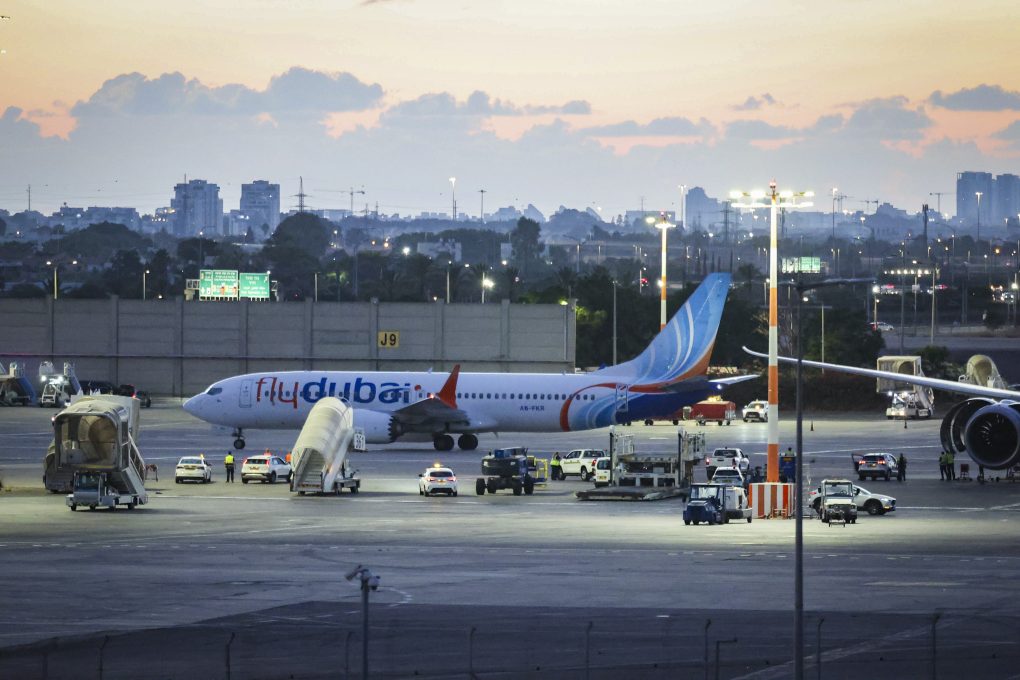
JERUSALEM (VINnews) — The attempted attack aboard a Flydubai flight bound for Israel could have ended in one of the worst aviation disasters in recent memory, according to veteran El Al captain Alon Pereg, who has reconstructed the sequence of events and identified what he believes were four extraordinary factors that prevented catastrophe.
Join our WhatsApp groupSubscribe to our Daily Roundup Email
Speaking on the Israeli podcast Al Haperek, Pereg, a former fighter pilot and senior El Al captain with tens of thousands of flight hours, said the September 30 incident aboard Flydubai Flight FZ1073 was a rare case in which aviation authorities were able to learn from a near-disaster without lives being lost.
“Last week, we had four miracles, simply four miracles,” Pereg said. “We learned a lesson without paying a price.”
The flight, carrying 174 passengers, was traveling from Dubai to Tel Aviv when the Omani co-pilot, identified in international reports as Hamam al-Hammami, attacked Indian Captain Smit Machchhar in the cockpit. The United Arab Emirates prosecutor general has described the incident as an attempted terrorist act and said the co-pilot attacked the captain with a crash axe while attempting to seize control of the aircraft. The investigation into his motives and possible connections remains ongoing.
The First Miracle: The Captain Opened The Cockpit Door
According to Machchhar’s own account, the co-pilot had asked for time to pray before attacking him from behind. Machchhar was severely injured and initially struggled to reach the cockpit door. After hearing passengers screaming as the aircraft began a sharp descent, he made another attempt and succeeded in opening the door.
That decision proved critical. “Had the door not opened, the first officer would have been locked in the cockpit,” Perag said. “From there, he could do whatever he wanted — he could crash the plane.”
Machchhar’s account, reported after the incident, confirms that he was barely able to see after the attack but summoned enough strength to open the door. Passengers outside then rushed into the cockpit and helped overpower the co-pilot.
The Second Miracle: Passengers Fought Back
Once the cockpit door opened, passengers and crew members intervened. Israeli passengers helped restrain the attacker, while others assisted the badly injured captain.
The response was particularly important because the aircraft was simultaneously undergoing an extreme descent. Flight-tracking data indicates that the Boeing 737 MAX lost approximately 14,000 feet in only 29 seconds, travelling at an angle of 39 degrees and a speed of Mach 0.96.
One passenger, Israeli businessman Yaniv Hayoun, has said he briefly moved to the controls as the aircraft descended. His intervention helped stabilize the aircraft until qualified pilots could take over. Pereg praised the passengers who refused to remain passive.
“Four brave Israelis did not do what we were taught to do — sit and do nothing,” he said. “They got up and fought, as Israelis know how to do.”
The Third Miracle: Two Extra Pilots Were On Board
Perhaps the most remarkable coincidence was that two additional pilots happened to be traveling as passengers on the flight. The pilots were “deadheading”, traveling as passengers because they were scheduled to operate the aircraft on its return flight from Tel Aviv to Dubai. When the cockpit was secured, they were able to take control of the aircraft and complete the emergency landing.
Passenger Daniel Schlichter described their presence as “one of the miracles,” noting that the two pilots would not normally have been on every flight.
They ultimately guided the damaged aircraft to Prince Sultan bin Abdulaziz Airport in Tabuk, Saudi Arabia, where it landed safely. All passengers survived.
The Fourth Miracle: The Boeing 737 Survived
Perag also highlighted the aircraft itself. The extreme descent apparently placed the Boeing 737 MAX under extraordinary aerodynamic stresses. Photographs taken after the landing showed significant damage to the aircraft’s rudder.
Perag said the aircraft’s aerodynamic characteristics may have helped it recover from the dive and warned that an overly aggressive attempt to pull the aircraft out of the descent could itself have caused catastrophic structural damage.
“If someone had pulled the controls when the aircraft was flying much faster than it was designed to fly, with great force, trying to recover it, he could have caused enormous damage,” Perag said.
He argued that the aircraft’s survival despite exceeding normal operating limits demonstrated the robustness of the Boeing 737.
Alongside his praise for the captain, passengers and aircraft, Perag said the incident exposed serious security failures. He questioned how the co-pilot was permitted to operate a flight to Israel, particularly in light of reports that he had previously been removed from flying duties in Oman amid concerns over his ideological views. Those reports remain part of ongoing investigations and have not been fully confirmed by authorities.
Perag also questioned the Israeli screening process for foreign airline crews, arguing that security authorities receive crew information in advance and should examine how the pilot was cleared to enter Israel. “Someone fell asleep on watch,” he said.
The incident has already triggered broader scrutiny. Saudi Arabia has now launched a formal aviation-safety investigation under international rules, with the United States and the United Arab Emirates participating. The UAE is separately conducting a criminal investigation into the alleged terrorist attack.
Perag also warned of a wider aviation-security problem. Since the September 11 attacks, he said, enormous attention has been devoted to preventing people from breaking into the cockpit, while comparatively less attention has been paid to the possibility of a threat originating from inside it.
“We built a very strong fortress against someone breaking in from outside,” he said. “But there have already been cases of suicidal pilots. Anyone whose job is to think about security should have understood that one day terrorism from inside the cockpit could also happen.”
B”H There is nothing like Hashgachah Protis.
Something extraordinary DID happen aboard FlyDubai Flight FZ1073: HKB”H had all the life-saving solutions in place for all the challenges that would be happening on that plane!
Hodu l’Ad-noi ki tov. Ki l’olam chasdo!
There is really no solid protection against terror emanating from inside the cockpit. They need to develop a system where in the event of a hijacking the flight controls are taken over by a ground team who continue to fly the aircraft to safety. All the controls onboard become nonfunctional at that time.
‘should examine how the pilot was cleared to enter Israel. “Someone fell asleep on watch,” he said.’
‘Those reports remain part of ongoing investigations ‘
I guess the oct 7th security failures are also still under investigation. Maybe that’s why nothing changed. The same people in charge are still there and responsible for investigating and firing themselves. And before an election, how convenient.
They are either incompetent or operating a malicious agenda.
i doubt the airplane is repairable.
I wonder what the not-yet-frum mean when they say miracles. Do they realize that they are saying that Hashem did something extraordinary, or they just mean that something extraordinary happened. Or maybe depending on their meaning will change how long they are not-yet-frum!