
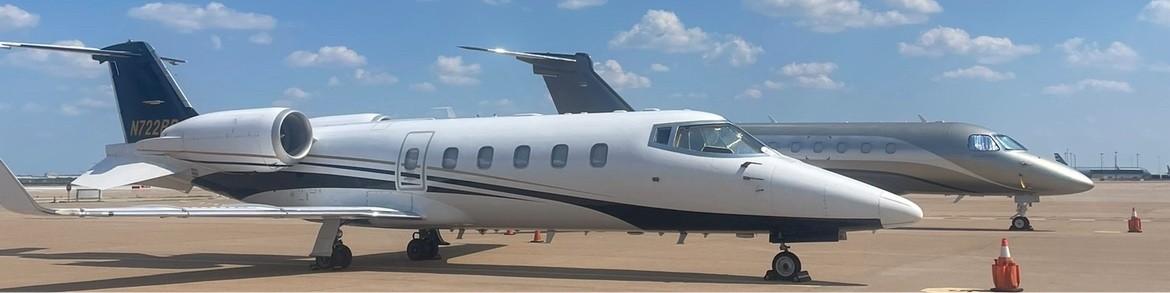
(VINnews) – The Learjet 60 is a high-performance midsize business jet that has been flying for more than three decades. Although the aircraft was certified by the Federal Aviation Administration (FAA) in January 1993 and remains an approved aircraft design, its history includes several serious accidents, a deadly runway disaster that exposed significant maintenance and design deficiencies, and mandatory federal safety requirements introduced following the investigation.
Join our WhatsApp groupSubscribe to our Daily Roundup Email
The aircraft, manufactured by Learjet, a company later acquired by Canadian aerospace manufacturer Bombardier, became popular among corporate executives, private charter operators and wealthy individuals because of its speed, climbing performance and ability to travel between major cities without the need for a larger business jet.
But its history is more complicated than its reputation for performance suggests.
Sunday’s catastrophic crash in South Florida, involving a Learjet 60 registered as N722BD, has once again drawn attention to the aircraft’s safety history. The aircraft crashed in Palm Beach County, Florida, killing those aboard. Investigators are examining the circumstances surrounding the disaster, including weather conditions, aircraft systems and maintenance records.
The cause of the latest crash has not been established, and it would be premature to attribute it to a particular aircraft defect.
FAA certification and the aircraft’s development
The Learjet 60 received FAA type certification on January 15, 1993, under federal airworthiness standards for transport-category aircraft, known as Part 25.
Interestingly, the Learjet 60 was certified as a derivative of an existing Learjet design rather than receiving an entirely new type certificate. It was added to Learjet’s existing Type Certificate A10CE, originally issued for the Learjet 24 in 1966.
This certification process allowed the manufacturer to develop an extensively modified aircraft while relying on portions of the earlier certification framework where the FAA determined that the changes permitted such treatment.
FAA certification means the aircraft’s design was found to meet the applicable regulatory requirements. It does not mean that every individual Learjet 60 is automatically airworthy today. Each aircraft must continue to comply with maintenance requirements, inspections, applicable airworthiness directives and operating limitations.
The beginnings of the Learjet 60
Learjet was founded by American inventor and entrepreneur William P. Lear, who helped pioneer the private business jet industry during the 1960s.
His vision was to bring military-inspired jet performance to corporate aviation. Early Learjet aircraft became synonymous with speed, luxury and executive travel, establishing the company as one of the most recognizable names in private aviation.
By the late 1980s, however, Learjet was facing growing competition from manufacturers producing larger, more comfortable and increasingly capable business jets.
In 1990, Canadian aerospace company Bombardier acquired the Learjet business from Integrated Resources. Bombardier wanted to revive the brand and expand its position in the midsize business jet market.
One of its first major projects was the Learjet 60, an extensively improved version of the Learjet 55.
The Model 55 had struggled commercially because of its relatively cramped cabin and performance limitations, particularly in hot-weather operations. Bombardier believed a substantially improved aircraft could compete more effectively with the Hawker 800 and other midsize business jets.
Development costs for the Model 60 were estimated at less than $100 million, and the company targeted certification within three years.
The aircraft made its first flight on October 10, 1990, and received FAA certification in January 1993.
A powerful aircraft built for speed
The Learjet 60 represented a substantial improvement over its predecessor.
It was powered by two Pratt & Whitney Canada PW305A turbofan engines, each producing approximately 4,600 pounds of thrust.
The engines gave the aircraft impressive climbing performance, allowing it to reach approximately 41,000 feet in 18 minutes under favorable conditions.
Its maximum operating altitude is 51,000 feet, allowing it to fly above much of the commercial airline traffic and certain weather systems.
The fuselage was extended by approximately 43 inches, creating additional cabin space. Depending on configuration, the aircraft could accommodate up to eight passengers and a two-person flight crew.
The cabin featured executive seating, a galley, an aft lavatory and baggage storage.
Its maximum range was approximately 2,400 nautical miles, depending on payload, weather and operating conditions.
The aircraft became attractive to private operators seeking a fast midsize jet capable of connecting major business destinations.
Early production shortcomings and improvements
Despite its impressive performance, the Learjet 60 experienced several shortcomings during its early years.
Aviation industry reviews identified problems involving engine components, batteries, brakes and the auxiliary power unit.
An auxiliary power unit, or APU, allows an aircraft to generate electrical power and, depending on its configuration, provide cabin conditioning while the main engines are shut down.
Bombardier addressed several of the aircraft’s early shortcomings through service bulletins, modifications and supplemental type certificates.
In 2004, the company introduced the Learjet 60SE, which featured an increased maximum takeoff weight, a standard APU, traffic collision avoidance technology, enhanced ground proximity warning equipment and interior improvements.
The aircraft also received upgraded triple-disc brakes, designed to provide improved stopping performance and longer overhaul intervals.
The Learjet 60XR arrived in late 2007, featuring the Collins Pro Line 21 integrated avionics suite, an upgraded cockpit and additional cabin configurations.
The original Learjet 60 generally used Collins Pro Line 4 avionics.
Production of the original Learjet 60 ended in 2007, while the upgraded 60XR continued until 2013.
Approximately 314 original Learjet 60 aircraft were produced, making it a significant model in the company’s business aviation history.
The 2008 crash that exposed serious safety deficiencies
One of the most consequential accidents involving the Learjet 60 occurred on September 19, 2008, at Columbia Metropolitan Airport in South Carolina.
The aircraft, registered N999LJ and operated by Global Exec Aviation, was preparing for a flight to Van Nuys, California.
During its takeoff roll, all four main landing-gear tires failed.
The captain attempted to abort the takeoff after the aircraft had passed its designated decision speed, known as V1. The jet could not stop within the remaining runway distance.
It overran the runway, struck objects and burst into flames.
Four people were killed, including both pilots and two passengers. The two surviving passengers were musician Travis Barker, formerly of Blink-182, and DJ AM.
The National Transportation Safety Board conducted an extensive investigation that uncovered serious problems.
Investigators determined that the aircraft’s tires were severely underinflated. The operator had not checked the tire pressure for approximately three weeks.
The recommended tire pressure was approximately 219 psi, but investigators determined that the tires had fallen to approximately 140 psi.
The underinflated tires overheated and failed during the takeoff roll.
But the investigation uncovered another troubling problem.
Fragments from the failed tires damaged critical components in the wheel-well area, including components associated with the thrust-reverser system.
Thrust reversers are designed to redirect engine thrust during landing to help slow an aircraft. In this accident, damage to the system permitted uncommanded forward thrust, making it even more difficult to stop the aircraft.
The NTSB also determined that deficiencies in Learjet’s thrust-reverser design and the FAA’s certification review contributed to the severity of the accident.
Investigators noted that a similar uncommanded forward-thrust incident had occurred in 2001, but the resulting safety analysis failed to identify and correct the underlying design deficiencies.
The NTSB identified several contributing factors, including inadequate tire maintenance, shortcomings in industry training for tire-failure emergencies and poor crew resource management.
The investigation resulted in six new safety recommendations to the FAA.
The FAA responds with mandatory tire-pressure requirements
One of the most significant consequences of the 2008 investigation was the introduction of stricter tire-maintenance requirements.
Following the accident, Bombardier issued revised flight-manual procedures requiring Learjet 60 and 60XR tire pressures to be checked within 96 hours before takeoff.
The FAA subsequently issued Airworthiness Directive 2010-11-11, effective July 13, 2010.
The directive made the revised maintenance and operating procedures mandatory for affected Learjet 60 aircraft.
The requirement is particularly important because investigators determined that tire-pressure loss can accumulate over time, creating internal heat damage and increasing the likelihood of tire failure.
The NTSB also highlighted the need for improved tire-pressure monitoring, maintenance procedures and pilot awareness.
The fact that a federal airworthiness directive was issued following the accident illustrates how seriously regulators treated the identified safety deficiencies.
Other documented Learjet 60 accidents
The 2008 disaster was not the only serious accident involving the model.
On January 14, 2001, a Learjet 60 operated by Ark-Air Flight was involved in an accident in Troy, Alabama. No fatalities were reported.
On October 7, 2002, another Learjet 60, registered N5027Q, crashed during a landing at Santa Cruz do Sul Airport in Brazil. The accident resulted in one fatality.
On June 7, 2012, a Learjet 60 operated by Performance Aircraft Leasing was involved in an accident at Aspen-Pitkin County Airport in Colorado. No fatalities were reported.
On May 5, 2013, a Learjet 60 registered N119FD crashed while approaching Valencia Airport in Venezuela. Both pilots were killed.
On November 16, 2015, a Learjet 60 crashed during a landing at Zihuatanejo, Mexico. The aircraft sustained substantial damage, but no fatalities were reported.
Other recorded events involving the model include a 2018 brake-fire incident and a 2020 runway overrun near Wheeling, Illinois.
Not every recorded incident resulted in a crash or serious injury, and accident databases differ in how they classify incidents and aircraft events.
Nevertheless, the documented history shows that the aircraft has experienced serious accidents involving takeoff, landing, runway performance and mechanical systems.
Demanding runway requirements and tire maintenance
Another important characteristic of the Learjet 60 is its runway performance.
Despite its impressive speed and climbing ability, the aircraft has relatively small landing wheels, tires and brakes for a midsize business jet.
Its relatively high operating speeds and braking requirements demand careful runway planning, particularly in wet or contaminated conditions.
Some Learjet 60 pilots use what is known as the “5-6-7 rule” when planning midweight operations at low-elevation airports:
- Approximately 5,000 feet of runway on dry pavement.
- Approximately 6,000 feet on wet pavement.
- Approximately 7,000 feet on contaminated pavement.
These are planning guidelines, not universal FAA minimums. Actual runway requirements depend on aircraft weight, temperature, elevation, wind, runway conditions and other performance factors.
At maximum takeoff weight, under standard sea-level conditions, the aircraft requires approximately 5,450 feet of runway for takeoff.
At higher-elevation airports and in hot temperatures, the required distance can increase substantially.
Tire maintenance is another recurring consideration. Aviation Week’s 2024 review reported that main landing-gear tires may last approximately 150 to 200 landings, depending on operating conditions.
The aircraft’s mandatory 96-hour tire-pressure inspection requirement remains an important part of its maintenance procedures.
Pilot training and cockpit technology
The Learjet 60 is a high-performance aircraft requiring pilots to understand its operating limitations, weight-and-balance characteristics and emergency procedures.
Its high speeds and demanding runway requirements make proper flight planning and disciplined crew coordination particularly important.
The aircraft’s center of gravity also changes as fuel is consumed. A significant amount of fuel is carried in the aft fuselage, requiring pilots to account for changing weight distribution during flight.
The Learjet 60 and 60XR have dedicated pilot training programs offered by organizations including FlightSafety International and CAE.
Training covers aircraft systems, emergency procedures, simulator exercises and recurrent qualifications.
Depending on the aircraft’s configuration and upgrades, avionics can include traffic collision avoidance systems, enhanced ground proximity warning systems, weather radar, flight management computers and advanced navigation displays.
These systems provide pilots with information about surrounding aircraft, terrain, weather and aircraft performance. Their effectiveness, however, depends on proper training, maintenance and use.
Does the Learjet 60 have a poor safety reputation?
The Learjet 60 remains a capable business aircraft, and its speed and climbing performance have earned it a loyal following among private aviation operators.
Aviation Week’s June 2024 review described the aircraft as having solid reliability, despite its relatively short cabin and demanding maintenance requirements.
However, its history includes several serious accidents, and the 2008 NTSB investigation documented significant deficiencies involving tire maintenance, thrust-reverser design, certification and pilot training.
There is an important distinction between having a history of high-profile accidents and statistically having a higher crash rate than competing aircraft.
Establishing that the Learjet 60 has a higher accident rate would require comparing its accident history against total fleet flight hours, aircraft age, operating conditions and comparable business jets.
The available accident records alone do not establish that conclusion.
The aircraft has also undergone modifications and improvements throughout its production history, meaning individual aircraft can have substantially different maintenance and modification records.
A legacy now facing renewed scrutiny
The Learjet 60 was developed to restore one of private aviation’s most recognizable brands. It delivered the speed, performance and distinctive flying characteristics that had made Learjet famous.
But its history also illustrates the challenges of maintaining a high-performance business jet over decades of service.
With production ending in 2013, the remaining aircraft are aging and depend heavily on rigorous maintenance, inspections, parts availability and properly trained crews.
Sunday’s fatal crash in Florida adds another chapter to that history.
Investigators will now have to determine what caused N722BD to enter such a rapid descent and whether the aircraft experienced an aerodynamic, mechanical or other failure.
Until the NTSB completes its investigation, it would be premature to attribute the disaster to a particular design defect or conclude that it reflects a broader problem with the entire Learjet 60 fleet.
For an aircraft that helped carry the Learjet name into a new generation of private aviation, its safety history is once again receiving considerable attention.
nothing to do with weather, turbulence, ice, or pilot error in this article, just poo poo the plane