
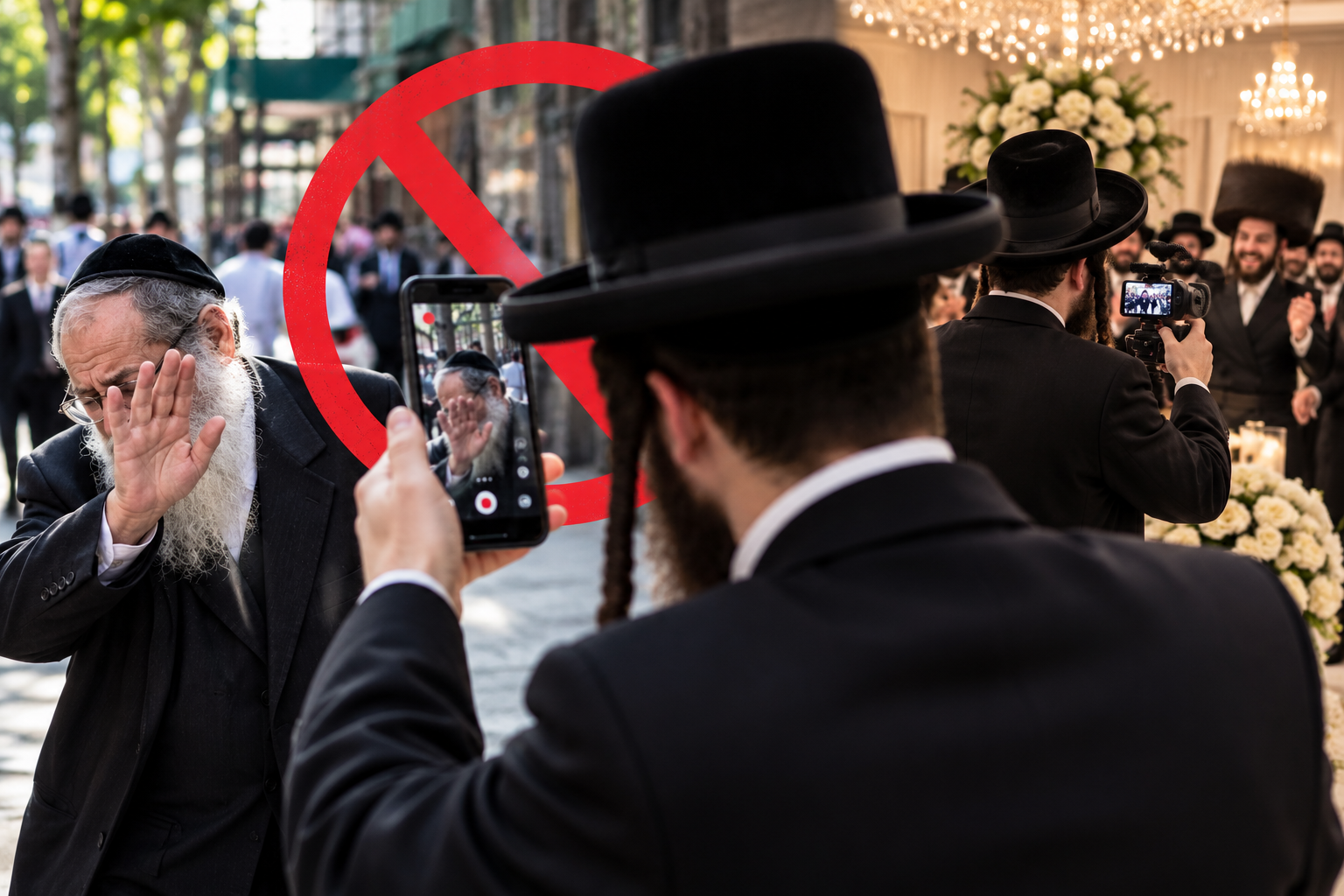
NEW YORK (VINnews/Editorial) – The Red Baron incident, which has gone viral with millions of views and sparked outrage across the United States, should serve as a wake-up call for the Jewish community, particularly in Williamsburg, where social media influencers have increasingly turned ordinary people, unsuspecting strangers and uncomfortable encounters into entertainment for thousands of followers.
Join our WhatsApp groupSubscribe to our Daily Roundup Email
This phenomenon is not limited to Williamsburg. It is happening among Jewish influencers from New York to Florida and everywhere in between. But we take particular issue with one influencer, a Williamsburg resident whose identity is well known to anyone familiar with the local social media scene.
He has made a habit of approaching ordinary people, provoking them, embarrassing them and publicly humiliating them, all while building a tremendous following. For him, an unsuspecting person on the street is often little more than an opportunity to generate another viral video.
Let’s call this what it is: exploiting ordinary people for entertainment.
And let us make another point absolutely clear: This behavior must stop. Approaching ordinary Jewish people on the streets, deliberately provoking them, putting cameras in their faces, embarrassing them and turning their reactions into online entertainment is unacceptable. People walking through Williamsburg, Borough Park, Miami Beach or anywhere else in our Jewish communities should be able to go about their daily lives without worrying that they might become the next target of someone’s Instagram stunt.
Whether in New York, Miami or elsewhere, ordinary Jewish people should not have to endure being provoked, embarrassed or humiliated simply because someone needs fresh content for their social media following. They did not volunteer to become content. They did not agree to be humiliated for somebody else’s entertainment. Their dignity deserves protection, just like anyone else’s.
But as troubling as the conduct of these influencers may be, there is another group that deserves a serious share of the blame: the people who invite them into their simchas.
Yes, you read that correctly. The hosts.
We are talking about families who invite these personalities to weddings, engagements and other celebrations, give them access to their private family occasions and effectively turn their simchas into promotional opportunities for social media accounts.
Why? For publicity. For exposure. For a few more views and followers.
And to those hosts, we have a message: You should be ashamed of yourselves.
You have every right to decide who enters your simcha. You can decline an invitation, deny access or make it clear that someone whose behavior conflicts with your values is not welcome. Nobody is entitled to a place at your wedding simply because they have a large Instagram following.
Yet what is particularly disturbing is that some of the very people who complain about these influencers’ behavior are the same people who willingly invite them, provide them with access and encourage them to broadcast their celebrations to the world.
You cannot have it both ways.
You cannot condemn someone for humiliating an ordinary worker in public while welcoming that same individual into your family celebrations for the entertainment and publicity value he provides.
The problem is not exclusively the person holding the camera. It is also the person opening the door.
The Red Baron incident should make that painfully clear.
An ordinary employee named Walt became the subject of a viral confrontation. What may have started as an attempt to generate online attention developed into a much larger controversy, attracting millions of views and prompting an outpouring of public reaction. A fundraising campaign in support of Walt also gained significant attention.
But the larger lesson should not be lost in the details of that particular incident.
Embarrassing, degrading and humiliating ordinary people for entertainment is wrong. It is not clever content. It is not harmless fun. And in a community that places such importance on menschlichkeit, it should be considered a serious violation of our most basic values.
Those who knowingly provide a platform, access and opportunities for individuals to engage in this behavior are not innocent bystanders. They are enabling it.
The solution is not complicated, but it requires courage.
Families should stop inviting influencers whose business model depends on provoking strangers and humiliating ordinary people. Wedding hosts should stop treating Instagram popularity as a credential. Community members should stop rewarding this behavior with attention, invitations and prestige.
There are plenty of ways to celebrate a wedding, share beautiful moments and promote a simcha without turning another person’s dignity into a marketing tool.
A large following does not make someone a role model. A viral video does not make someone respectable. And an invitation to a Jewish simcha should not be a reward for behavior that runs contrary to the values our community claims to uphold.
We need to stop pretending that this is only an influencer problem. It is a community problem, and the responsibility begins with the people who give these individuals access.
If you invite someone into your simcha knowing exactly how he makes his living online, you cannot wash your hands of what he represents.
Enough is enough.
Our simchas are not content studios. Our neighbors are not props. And ordinary people should not have to become the punchline of somebody else’s Instagram ambitions.
We Jews need to do better. The time has come to stop rewarding those who trade another person’s dignity for clicks, and to hold accountable those who make that possible.
Thanks for publishing this article
Yes this is against the ways of the Torah
I think there has to be some kind of legal argument to stop these bloggers. Same with the rasha Tyler. This idea that America has freedom of speech, I don’t believe entitles harassing strangers who haven’t caused you harm. There has to be a legal way to stop it. It’s insane
No idea what this article is talking about.
Same conversation is for sites like LakewoodScoop or BP24 that go around local streets and capture pictures of people in ways the people don’t want to be publicized. Why make of living of make fun of people.
what ‘incident” is he talking about?
VIN is referring to Chaimo
This is the first I am hearing about these influencers attending people’s Simchas.
Influencers are the bane of modern society. They should really be called the leaders of lemmings.
Becoming a publicity hound is not a Torah value and it is the antithesis of tzniyut.
Turning ordinary people into props for a viral clip is cheap content, but the hosts who invite those same creators into their family celebrations for exposure are the ones keeping the machine running.
If you want the noise to stop, the doors have to stay closed to anyone whose business model depends on public humiliation.
Their answer is that what they are doing is legal.
Because they believe in US law more than in the Torah.
We need to know that US law is not morality, it is often immoral, and should not be our guiding light.
It is also clearly clearly a violation of multiple Issurim. Beginning with Malbin Pnei Chaveiro Brabim, which is so severe that one can lose his Chellek in Olam Habah…
This, and some other recent vin posts, which run on much longer than necessary, seem AI written
I heard about the Red Baron story but never heard of the frum equivalent.
it isn’t the internet or social media that has gone crazy, it is the people involved
You reach for the screen when the house goes dark because the weight of the day follows you into the room. The feed offers a way to watch someone else’s spectacle instead of looking at your own life.
You call it unwinding. It is an escape valve. You keep watching the exact noise you claim to reject because it keeps you numb.
The device stays in your hand until the quiet in the room feels louder than the feed.
Written releases stop the stunt.
When every person appearing in client material signs an agreement beforehand, the production cycle stops relying on viral provocations for attention.
Focusing on who gets invited to a simcha misses the real waste. Decades of actual mastery vanish every week because the people who hold the knowledge never write it down.
When a fundraising campaign springs up overnight for someone caught in a viral stunt, the organizer almost always discovers that personal payment apps do not issue tax receipts.
A five-figure check needs a recognized charitable sponsor to land legally and cleanly.
There’s a bais din that operates that way, reactivating old cases that was decided by another bet din years before.