
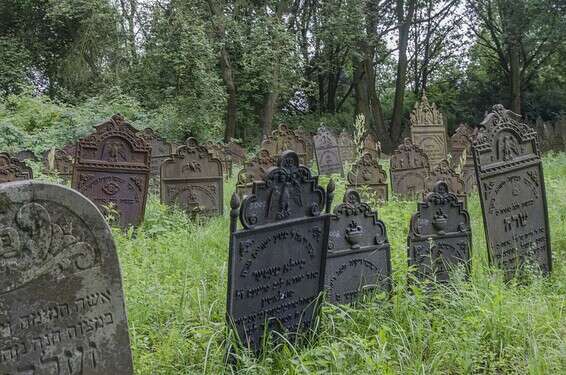
WARSAW (VINnews) — A major cleanup operation at a historic Jewish cemetery in Sieradz, central Poland, has uncovered buried grave remains, stone frames and fragments of tombstones that had been hidden beneath dense vegetation and overgrown trees for decades. The discoveries are part of an ongoing effort by local volunteers to restore the neglected site and preserve the memory of the town’s once-thriving Jewish community.
Join our WhatsApp groupSubscribe to our Daily Roundup Email
The restoration work was initiated by local heritage activist Cezary Zbrojewski, in cooperation with the Guardians of Remembrance association from Lodz, local volunteers and members of the town’s Scout movement. The results were presented at a special memorial ceremony held at the cemetery on Zakładników Street, coinciding with Poland’s All Saints’ Day observances.
The cemetery, established in either 1804 or 1812 according to differing historical accounts, contains the remains of generations of Jewish residents of Sieradz. Although no complete tombstone has survived, fragments of gravestones and other traces of the original burial site have remained beneath the vegetation.
The cleanup has already produced significant discoveries. During an earlier round of work in June, volunteers uncovered an almost completely intact matzevah that had apparently been buried for decades. Its Hebrew inscription was translated, identifying the deceased as Jona, son of Jacob Aharon, who died on November 8, 1916.
The cemetery also has a painful history connected to the Nazi occupation. On November 14, 1939, German forces murdered 20 local hostages at the site. A monument now commemorates the victims. Their remains were later exhumed and transferred to a mass grave at the town’s Catholic cemetery.
The wider Jewish community of Sieradz was almost entirely destroyed during the Holocaust. In August 1942, the Germans rounded up more than 3,000 Jewish residents and confined them in a monastery before deporting most of them to the Chełmno extermination camp. Only a small number survived the war.
The restoration in Sieradz highlights the difficult condition of Jewish cemeteries elsewhere in Poland. In Częstochowa, the historic Jewish cemetery on Złota Street was established around 1799 and contains thousands of surviving tombstones, some dating to the early 19th century. During World War II, the Germans carried out mass executions there and ordered tombstones to be removed and reused for construction work.
After the war, the cemetery suffered further damage. Part of its grounds was taken over by a local steelworks in the early 1950s, while neglect and vegetation gradually damaged the remaining graves. Although the site is recognized as a historic monument, significant preservation challenges remain.
In the northern Polish city of Słupsk, the Jewish cemetery, established in 1815, was largely destroyed during and after the Nazi period. The Jewish community was forced to sell the property in 1941, and parts of the cemetery were subsequently incorporated into other uses. The remaining gravestones were removed under communist-era municipal authorities in the 1970s.
One important structure has survived: the former funeral house, built in 1907–1908 at the cemetery entrance. Today, it stands on a street named after Max Joseph, the city’s last prewar rabbi, who emigrated to Palestine in 1936.
The Sieradz project is part of a broader effort across Poland to protect Jewish cemeteries, many of which have been left neglected since the destruction of their communities during the Holocaust.
Jewish Heritage Europe reported in September that more than 100 cemetery-cleaning initiatives had taken place or were planned across 18 countries during 2026. In Poland, such projects frequently bring together local residents, heritage organizations, students and descendants of former Jewish communities.
For the volunteers in Sieradz, the work is about more than clearing trees and uncovering old stones. Each recovered fragment offers another connection to the Jewish families who once lived in the town and helps ensure that their history is not forgotten.