
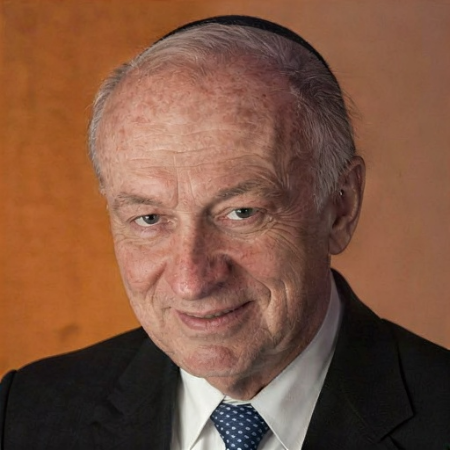
NEW YORK (VINnews/Rabbi Yair Hoffman) — Rabbi Julius Berman, a towering lay leader of American Orthodoxy whose influence spanned Jewish law, public policy, Holocaust restitution and the preservation of Torah scholarship, died Tuesday at the age of 90. His death came on the final day of 2025, Jewish communal organizations said.
Join our WhatsApp groupSubscribe to our Daily Roundup Email
Rabbi Berman, widely known as Julie, was regarded as one of the most consequential Orthodox Jewish leaders in the United States over the past half-century. He combined elite legal expertise with deep Torah learning and a lifelong commitment to Jewish communal service, shaping institutions that continue to define American Jewish life.
Born in 1935 in Dūkštas, Lithuania, Rabbi Berman escaped Europe as a child after his father, Rav Henoch Berman, recognized the growing danger facing Jews under Nazi occupation. In April 1940, the family fled Lithuania and immigrated to the United States, settling in Hartford, Connecticut — just months before the Jewish communities of the region were annihilated.
In Hartford, Rabbi Berman was among the first graduates of the Yeshiva of Hartford before continuing his studies at Yeshiva Torah Vodaas in Brooklyn. He later enrolled at Yeshiva University, where he became a close disciple of Rabbi Joseph B. Soloveitchik, one of the most influential Jewish thinkers of the 20th century.
The relationship would shape the rest of Rabbi Berman’s life. Over time, he became Rabbi Soloveitchik’s lawyer, literary agent and personal confidant. As Rabbi Soloveitchik’s health declined and Parkinson’s disease forced him from public teaching, Rabbi Berman was entrusted with preserving hundreds of recorded lectures and manuscripts. In a 1984 letter, Rabbi Soloveitchik formally instructed him to take custody of the materials and ensure their preservation and publication.
Rabbi Berman went on to help found the Toras HaRav Foundation and OU Press, which together published dozens of volumes of Rabbi Soloveitchik’s writings. The Koren Mesorat HaRav Siddur, now widely used in synagogues and homes around the world, emerged from that effort.
Ordained by Yeshiva University’s Rabbinical Seminary, Rabbi Berman simultaneously pursued a legal career, graduating first in his class from New York University School of Law in 1960. He joined the law firm Kaye Scholer in 1959 and became a partner a decade later — a rare achievement at the time for a strictly Sabbath-observant Jew in a major American firm.
He later reflected that his choice of law over the pulpit enabled him to serve the Jewish community more broadly. “It is very possible that my decision to go into a legal career rather than the Rabbinate had a role to play in my immersion in Jewish communal matters,” he said in a 2006 interview.
Rabbi Berman’s communal leadership included serving as president of the Orthodox Union from 1978 to 1984, a period during which the organization launched Yachad, its pioneering program for Jews with developmental disabilities. He later chaired the Conference of Presidents of Major American Jewish Organizations, becoming the first Orthodox layperson to hold the position.
He also served as chairman of the OU Kashrut Commission, founding chairman of OU Press, chairman emeritus of the RIETS board of trustees, chairman of the Jewish Telegraphic Agency and president of the American Zionist Youth Foundation.
Perhaps most prominently, Rabbi Berman devoted decades of service to the Conference on Jewish Material Claims Against Germany, eventually serving as its president. Under his leadership, billions of dollars in restitution and social services were delivered to Holocaust survivors worldwide.
In 2015, the Claims Conference distributed $60 million in a single day to child survivors of the Holocaust. Announcing the initiative, Rabbi Berman emphasized the lasting trauma endured by those who survived in hiding, separated from parents and deprived of childhood.
Greg Schneider, executive vice president of the Claims Conference, called Rabbi Berman “a towering moral leader whose life’s work helped shape the global landscape of Holocaust survivor care, restitution and Jewish communal life.”
Colleagues consistently described Rabbi Berman as a consensus builder whose authority stemmed from integrity and humility as much as intellect. Rabbi Menachem Genack, a senior Orthodox Union official, said that in meetings “everybody ultimately would defer to Julie Berman.” Dennis Rapps, a longtime Jewish communal executive, described him as widely respected across ideological lines for his selflessness and clarity of purpose.
Despite his public responsibilities, Rabbi Berman was known as a devoted family man. He is survived by his wife, Dorothy; three children; and grandchildren. His son, Rabbi Zev Berman, serves as president of the National Council of Young Israel.
Funeral services for Rabbi Berman are scheduled for Thursday at Young Israel of Jamaica Estates, located at 83-10 188th St. in Queens. The service will begin at 10:30 a.m. and will be livestreamed by the synagogue. Burial will follow at New Montefiore Cemetery, at 1180 Wellwood Ave. in West Babylon on Long Island.
Jewish organizations described Rabbi Berman as one of the most significant lay leaders of modern Orthodoxy, citing his role in preserving Torah scholarship, expanding Orthodox participation in public life and securing dignity for Holocaust survivors in their final years.
The author can be reached at [email protected]
BDE. I had the honor of davening with him when he came to KGH and visited his son, Zev. A role model for any Yid.