
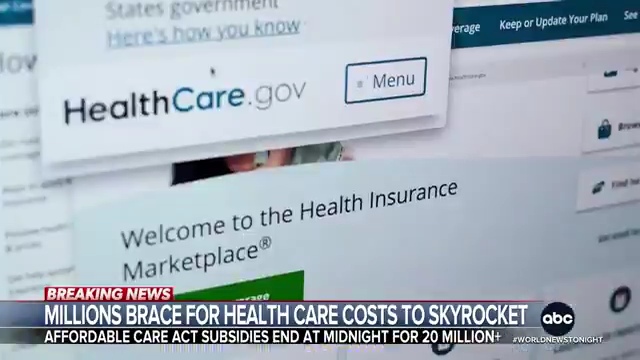
NEW YORK (VINnews) — More than 20 million Americans who purchase health insurance through the Affordable Care Act marketplaces are facing significantly higher premiums starting Jan. 1, 2026, after enhanced premium tax credits expired at the end of 2025 without congressional action to extend them.
Join our WhatsApp groupSubscribe to our Daily Roundup Email
The enhanced subsidies, first introduced in 2021 under the American Rescue Plan Act and extended through 2025 by the Inflation Reduction Act, made coverage more affordable by increasing subsidy amounts and eliminating an income cap that previously limited eligibility.
According to estimates from the Kaiser Family Foundation (KFF), subsidized enrollees’ out-of-pocket premium payments are projected to more than double on average in 2026, rising 114% from about $888 annually in 2025 to $1,904. Some individuals could see their premiums triple or quadruple, particularly older enrollees or those in higher-cost areas.
Record enrollment in ACA marketplaces reached approximately 24 million people in 2025, largely driven by the enhanced subsidies that allowed many lower-income households to obtain plans with little or no monthly premium and capped contributions for higher earners at 8.5% of income.
Without the enhancements, eligibility reverts to pre-2021 rules, reinstating a “subsidy cliff” where households earning above 400% of the federal poverty level — roughly $62,600 for an individual or $129,000 for a family of four in 2025 guidelines — lose access to subsidies entirely.
Experts warn that the expiration could lead to millions dropping coverage, with projections from the Congressional Budget Office and other analysts estimating 3-4 million fewer insured individuals in coming years. States like Florida and Texas, with the highest numbers of subsidized enrollees, are expected to be hardest hit.
Congressional efforts to extend the subsidies stalled in late 2025 amid partisan divisions. Democrats pushed for a multi-year extension, while Republicans sought reforms or alternatives, including potential limits on eligibility. A Democratic-led bill for a three-year extension is expected to receive a House vote in January 2026, though its prospects in the Senate remain uncertain.
Some states are offering additional assistance to mitigate impacts, but most enrollees will face higher costs immediately. Open enrollment for 2026 coverage has closed in many states, locking in plans under the new premium structure.