
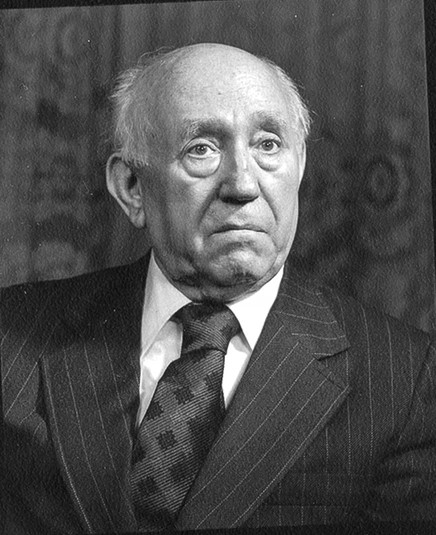
by Rabbi Yair Hoffman
Join our WhatsApp groupSubscribe to our Daily Roundup Email
In February 2013, the papers and library of Chaim Grade, a once ben bayis by the Chazon Ish zt”l, comprising twenty thousand volumes, were jointly acquired by the National Library of Israel and YIVO Institute for Jewish Research. This acquisition marks an important milestone in preserving the legacy of a man whose life embodied a profound spiritual struggle—a talented soul who, unfortunately, walked away from the path of Torah.
Early Years and Torah Education
Born on April 4, 1910, in Vilna to Reb Shloyme-Mordkhe Grade, a melamed, and Vela Blumenthal, the daughter of a rabbi, Chaim’s early life was marked by hardship. The First World War brought hunger and displacement to the family, eventually leading them to a small, dark apartment at 15 Jatkowa Street in Vilna, where Chaim would remain with his mother until the late 1930s.
Despite difficult circumstances, Vela insisted that her son attend a yeshiva. She chose for him the most demanding of institutions—the Musar yeshivos of Novardok—known for their exacting standards of moral conduct and self-discipline. Between 1924 and 1926, Grade studied in various Novaredker yeshivas, including those in Bialystok, Bielsk-Podlaski, and Olkenik.
Under the Wing of the Chazon Ish
In 1926, a pivotal moment occurred in Grade’s life when he met Rav Avraham Yeshaya Karelitz, known as the Chazon Ish, one of the greatest Torah sages of the generation, but as yet, unknown to the world. Perhaps it was Rav Chaim Ozer that introduced them, I no longer recall. The Chazon Ish, recognizing a promising yet troubled soul, accepted Grade as his personal student. He was a searching soul in need of spiritual guidance and the Chazon Ish recognized his innate talents. The Chazon Ish, offered Grade a slightly different path to the religious observance of Novardik.
A postcard written by Grade to the Chazon Ish in 1934 reveals the depth of their relationship and Grade’s internal struggle. In this heart-wrenching correspondence, Grade writes: “Literary Vilna recognized me as a strong poet, but I haven’t recognized myself yet as a human being. In order to save what has remained in me of your teaching, I must come to [be with] you in Bnei Brak — for my sake, and mainly for my mother’s sake…”
The Turning Away
Despite this spiritual yearning, Grade did not go to Bnei Brak to continue his studies with the Chazon Ish. Instead, he began moving in Vilna’s literary circles. On March 16, 1934, he published his first poem in the Vilner Tog, marking the beginning of his departure from the yeshiva world.
By 1936, Grade had published his first collection of poetry, titled “Yo” (Yes). He moved out of the small space he had shared with his mother (1935), married Frume-Libe Klepfish (1937), and won a literary prize (1939). His talents were now being directed not toward Torah commentary nor toward inspirational religious poetry, but toward a darker path – secular Yiddish literature.
Those who were close to the Chazon Ish said that he kept up with Chaim Grade. And this author has often wondered if the Chazon Ish’s more lenient position on a tinok sh’nishba might have been informed by his his relationship with Chaim Grade.
War and Survival
When the Germans invaded in June 1941, Grade fled eastward into the Soviet Union, leaving his wife behind. She tragically perished in the Vilna Ghetto. Grade’s journey took him through Kazakhstan, Turkmenistan, and Tajikistan before he eventually reached Moscow in late 1943. As a member of the Union of Soviet Writers, he was able to secure rations and avoid being drafted into the Soviet army.
After the war, in August 1945, Grade returned briefly to Vilna, a pilgrimage to the site of immeasurable personal and communal loss. By December of that year, he had married again. Inna Hecker. Soon after he made his way to Łódź, Paris, and finally New York in 1948.
Literary Legacy and Spiritual Questions
In the years following the Holocaust, Grade produced works that grappled with the destruction of European Jewry and his own religious past. His novel “Tsemakh Atlas” (1967/68) and the stories in “Di kloyz un di gas” (The Study House and the Street, 1974) reveal his continued preoccupation with the world of the Yeshiva that he had left behind.
The tension between secular and religious life, between modernity and tradition, forms the core of Grade’s literary work. Opposing worldviews. His characters are each armed with convincing arguments—reflecting the author’s own inner turmoil. His unresolved spiritual questions.
Relationship with the Lubavitcher Rebbe
Grade had readers everywhere. The Israeli Zionist elite read his works as did the Lubavitcher Rebbe. In the summer of 1971, Chaim Grade fell ill and was hospitalized. Inna, his second wife, called the Rebbe’s secretariat to relay the news and request his blessing for the writer’s recovery and good health. Previously Grade had made an introduction to the Rebbe of Shazar, an Israeli politician. The Rebbe soon wrote to Grade, expressing “my hope … that an improvement has occurred in your health, which will only continue to improve to the point that, with G‑d’s help, you will return home…” Taking a lighter tone, the Rebbe quipped that the “Sons and Daughters” are “of course awaiting the author’s sequels.”8 This was a reference to Grade’s novel Zin un Tekhter, which was serialized in the Tog-Morgn Zhurnal between 1968 and 1971.
What Might Have Been
One cannot help but wonder what might have been had Grade chosen to return to the Chazon Ish in Bnei Brak. With his profound literary gifts and deep understanding of Torah and Musar thought, he might have become one of the greats. Imagine Chaim Garde, of the top Jewish religious writers of the 20th century, a member of Agudath Yisroel. illuminating the depths of Torah wisdom for generations to come. But alas, it was not to be.
On October 5, 1962, Grade did visit the grave of the Chazon Ish in Bnei Brak. Did he apologize to him? Did he wonder what could have been? One can only imagine the thoughts that must have passed through his mind as he stood at the final resting place of the rabbi who had once offered him spiritual refuge.
If only Grade had channeled his remarkable talents toward strengthening Torah values rather than secular literature. If only he had completed the journey back to his roots that he so poignantly expressed in his 1934 letter. The Torah world might have been enriched with works that combined literary brilliance with the eternal wisdom of Torah, instead of being left to wonder about the path not taken by this gifted son of Vilna.
The author can be reached at [email protected]
There is a piece on the internet by David Fishman (“the Bareheaded Rosh Yeshiva”) who met Chaim Grade in the 1960’s when he (Fishman) was in YU and a talmid of Rav Aharon Kreiser zt’i. Grade asked which Mesechta and Daf are you learning? When Fishman told him, Grade recited the Daf from memory as well as a summary of Rashi and Toasfos
I do not hear here of a תינוק שנשבה. Rather, I hear of a victim of trauma. His internal struggles were perhaps caused by his dire situations. Regardless, these external troubles intensified his conflicts. It is certainly a shame that he was not successfully guided back to the path of Torah. This story stands out in that the individual achieved notoriety in other circles. We, however, need to realize that there are many of these Chaims among us, albeit without achieving any recognition in the secular world. Many of our Gedolim address the subject of emunoh as a theme for our avodah. I just wish I could say that we fulfill that mandate properly.
The author must surely be aware of the correspondence and relationship between him and the Lubavitcher Rebbe, who incidentally sent him Shmirah Matzah each year to his absolute delight. (Delivered by R’ Duchman to his Bronx home)
Ben Bayis ‘of’ the Charon Ish , not “by” …
Are we supposed to say “If only” if something happened? It was hashgacha pratis and we can learn from the mistakes. We need to daven that the yetzer hara doors not influence us and that all of our fellows Jews become better Jews.
Chaim wrote articles every week in the forward. I believed it was called the yeshiva and it was about pre war life . He spoke about all the scandals and gossip of those times. Many chashuva rosh yeshivas in America would run to buy the forward to see what gossip and which RY of Europe or prestigious student would be in the paper. He generally used pen names and not real names . But those the knew knew. The Chazon ish was the machzah Avraham. I also believe its disputed if he really ever went to the Chazon ish kever
In the paragraph entitled “what might have been”, six lines down, you misspelled the word Grade with Garde. Please do Tsuevah.
I’m not sure why this person deserves a full article about his life on a frum site.
He left observance & belief in Judaism so we have nothing to do with him.
He was OTD