
By R. Yair Hoffman that Includes Thoughts from the New Yare’ach LaMoadim on Chanukah
Join our WhatsApp groupSubscribe to our Daily Roundup Email
CHARACTERS:
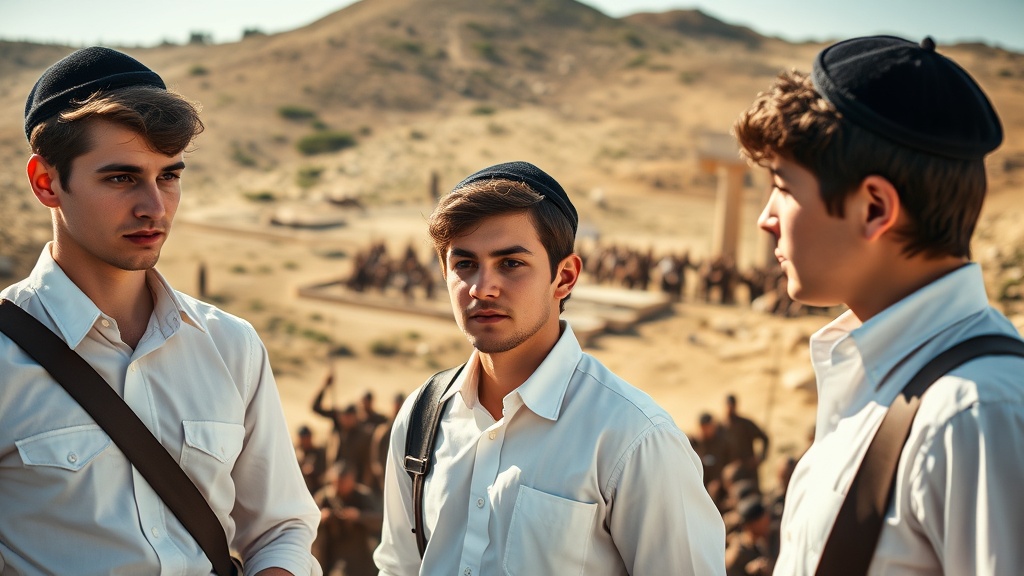
- MOSHE FRIEDMAN: A thoughtful, scholarly BMG student
- DOVID KLEIN: An enthusiastic BMG student with a passion for history
- YITZCHAK BERNSTEIN: A quiet but wise BMG student
- YEHUDAH MACCABEE: The legendary Jewish warrior and leader
- SYRIAN SOLDIERS
- HELLENIST JEWS
- SOLDIER 1: A Maccabee soldier
- OTHER MACCABEE WARRIORS
ACT I: THE JOURNEY BACK
[Scene: BMG Study Hall (Beis Medrash), Lakewood, New Jersey, Present Day MOSHE, DOVID, and YITZCHAK are learning together late at night during Chanukah break]
DOVID: [Looking up from his Gemara] You know, sometimes I wonder what it was really like during the times of Chanukah. To actually see the Beis HaMikdash…
MOSHE: [Closing his sefer] Just last week in his Vaad, Based on the Yesod v’Shoresh HaAvodah, Rav Olshin was explaining the deep connection between Chanukah and Purim and Rosh Hashanah.
YITZCHAK: Yes! He pointed out from the Tikunei Zohar how they’re both called “Moadai” and not “Moadei Hashem” – teaching to accept Ol Malchus Shamayim the yoke of Heaven through simcha – joy.
[Suddenly, a strange light fills the room. The three find themselves transported through time]
[Scene changes to a hillside near Modi’in, 165 BCE]
DOVID: [Looking around in disbelief] Where… when are we?
MOSHE: [Noticing ancient buildings and people in period clothing] This can’t be… [They hear sounds of battle in the distance]
YITZCHAK: Those clothes, that architecture… We’re in the time of the Chanukah story! And from the looks of the geography – it looks like we are in a valley near where Ofra is, or will be..
DOVID: Yitzchak, you are a Yeshiva bochur! How do you know the geography of Eretz Yisroel?
YITZCHAK: I have a modern cousin that learned in a seminary there. But there was a big battle there in Nachal el HaRamiah. This may be it. Yes, that guy there may be Appolonius the governor of Shomron and that person could be Yehudah Maccabee!
[Enter YEHUDAH MACCABEE with several warriors]
YEHUDAH: [Addressing his men] Brothers! The Greeks may have superior numbers, but we have faith in Hakadosh Baruch Hu!
MOSHE: [Whispering] That’s… that’s Yehudah Maccabee! He is the third son of Matisyahu who Matisyahu told to take over the revolt against Antiochus IV! Oh my, he just killed that Appolonius guy and look – he is taking his sword!
YEHUDAH: I will continue using this sword to fight off the Yevanim!
YITZCHAK: Yes, he ended up using that sword his entire life. Wow, we are watching history unfold before our eyes! Can you imagine seeing Yehudah Maccabee himself!
DOVID: I wonder where the word Maccabee comes from..
YITZCHAK: Some say that Maccabee comes from the aramis word for hammer – Makaba! But we have a Mesorah that it comes from rashei taivos of Mi Kamocha ba’Ailim Hashem. From Shmos tesvov..
ACT II: THE MEETING
YEHUDAH: [Noticing the 3 students] Who are you? Your clothing is wierd, yet you appear to be Jews.
DOVID: [Stepping forward, trembling] We… we are students from the future. From a place called Lakewood, where thousands study Torah day and night.
YEHUDAH: [Interested] The future? Thousands study Torah openly? Then we must ultimately succeed in our fight against the Greeks! I knew it!
MOSHE: Yes, but it’s what you taught us that allows Torah to flourish. The message of mesiras nefesh, of complete dedication to Hashem. It is mesiras nefesh for Torah and its lifestyle that allows the future to flourish
YITZCHAK: Our Rosh Yeshiva, Rav Yeruchem Olshin, taught us something remarkable about this very time. The 25 days of Chanukah correspond to the 25 letters in “Shema Yisrael.”
YEHUDAH: [Eyes lighting up] “Shema Yisrael” – the declaration of Hashem’s unity. This is exactly what we fight for! But we better get you to a safer place for now.. We have a war camp not far from here. Follow us..
[Scene shifts to a makeshift war camp]
MOSHE: The Tikunei Zohar reveals that when you rested on the 25th of Kislev – “Chanu Chaf-Heh” – it corresponded to these 25 letters. Your victory came through complete emunah in Hashem’s oneness.
YEHUDAH: Tell me more about what is learned in your time about our struggle.
DOVID: We learned that Chanukah shares a deep connection with Rosh Hashanah and Purim. They’re all times of accepting ol malchus shamayim – the yoke of Heaven – through simcha, through joy.
YEHUDAH: Fascinating! You must tell me more but now we must travel to Beit Choron, there is a group of Yevanim that I wish to do battle with..
DOVID: Oh wow! I know where that is. That’s between Modiin and Yerushalayim right off Route 443. I pass it when I travel to my aunt’s house in Nof. ah.
YEHUDAH: [interrupting] Route 443? Are you referencing Rus, Dovid HaMelech’s ancestor, the tzadaikes?
DOVID: No, it’s kind of like another name for a road – like the one that is mentioned in Sefer Yehoshua perek yud when Hashem brought a big yeshuah for Klal Yisroel when He killed the enemy with huge hail stones..
YEHUDAH: Yes, I am familiar. I have bitachon that Hashem will help me against the Yevanim just as he helped Yehoshua.
DOVID: Oh, wow. BuHa
YEHUDAH: What’s BuHa?
DOVID: Oh it is short for Bracha v’Hatzlacha, a phrase that Rav Chaim Kanievsky zatzal, a future leader of Klal Yisroel will employ frequently to save time..
MOSHE: Say, Dovid, do you say zatzal about someone that wasn’t born yet?
YITZCHAK: I don’t see why not, Rav Chaim is a tzaddik and we are mentioning him..
MOSHE: Well, we better get going Yehudah Maccabee is starting off to Beit Choron..
NEXT SCENE IN BEIT CHORON
MOSHE: Rav Olshin also taught us something profound about the very name “Chanukah.”
YEHUDAH: [Intrigued] Tell me more about these teachings from your time.
MOSHE: The word “Chanukah” itself comes from “dedication” – specifically the rededication of the Second Beis HaMikdash.
YITZCHAK: Yes, and the Tzlach explains something remarkable about the Greeks’ true intention. They weren’t just trying to stop us from learning Torah…
DOVID: They wanted to defile the Beis HaMikdash itself and its oils specifically to drive away the Shechina – the Divine Presence.
YEHUDAH: [Deeply moved] You understand well. Every day we fight, we see how they took our holy Beis HaMikdash, trying to make it tamei. But how can they succeed? The Shechina has dwelt among our people since the days of our forefathers!
MOSHE: That’s exactly what makes the miracle so profound. The pure oil which will last for eight days wasn’t or isn’t just about light – it was a sign that the Shechina had returned to the Beis HaMikdash!
YEHUDAH: [Contemplative] So when we find that pure cruse of oil…
YITZCHAK: It will symbolize much more than just having fuel for the Menorah. Rav Olshin taught us that the main salvation of Chanukah was the return of the Shechina to the Beis HaMikdash.
DOVID: That’s why Chanukah is filled with such simcha, such joy. It’s not just about military victory…
MOSHE: It’s about the restoration of the deepest connection between Hashem and His people. But, please don’t tell anyone about the Nais that will transpire – it may affect the flow of history!
YEHUDAH: [To his soldiers] Do you hear, my brothers? When we fight to protect the purity of the Beis HaMikdash, we fight for the very presence of Hakadosh Baruch Hu among us!
SOLDIER 1: [Stepping forward] But Yehudah, how will we know when we have succeeded?
MOSHE: Uh oh! Too late Moshe, but let’s answer this soldier’s question. In our time, we learn that the miracle of the oil was the sign. When one pure cruse lasts for eight days. But please keep it a secret.
YITZCHAK: It will show that the Shechina has never truly left us, that it was just waiting for us to prove our devotion.
YEHUDAH: [To the three students] Your words strengthen us more than a thousand warriors. To know that in your time, these deep meanings are still studied and understood…
DOVID: Actually, you strengthen us more because of your incredible Bitachon that we see now.
YITZCHAK: Yes, our Rosh Yeshiva will point out to us in the future that just like you are going out with Bitachon – faith in Hashem – we have to learn from you to have bitachon in every Matzav – in every situation to have bitachon and to review Psukim of Bitachon.
MOSHE: A good example of this is like the pasuk that we say in Havdallah, Hinei Kel Yeshu’asi evtach velo efchad..
YITZCHAK: In fact, he once quoted a letter that Rav Yoseph Zundel from Salant will write to his son after he arrives in Yerushalayim..
YEHUDAH: Wait.. Who is Rav Yoseph Zundel, exactly?
YITZCHAK: Oh he will be the Rebbe of Rav Yisroel Salanter, the future founder of the Mussar Movement.. Anyway, he writes to his son back in Europe (in Sefer Ohr Yisroel letter #24) that he should not just rely on his own wisdom but to have Bitachon in Hashem in matters.
MOSHE: And our Rosh Yeshiva said that we must be inspired by your Bitachon that you are demonstrating here in battle.
YEHUDAH: Yes, we do have Bitachon! And it is nice to know that our Bitachon now will serve as an inspiration for future generations to have Bitachon in all that they do!
(End of Scene)
NARRATOR: THE CHASHMONAYIM WIN THE BATTLE AT BEIT CHORON AFTER WHICH YEHUDAH ADDRESSES THE 3 BMG TALMIDIM
YEHUDAH: We won Baruch Hashem! We now are off to Emmaus in the Valley of Ayalon. I hope to destroy the Yavanim that are led by two generals, Nicanor and Gorgias. Do you have any words of advice before we go?
DOVID: Yes, Rav Olshin taught us one more thing – the joy of Chanukah isn’t just a celebration of victory…
MOSHE: It’s the pure simcha of feeling the Shechina’s presence return to its proper place among Klal Yisrael.
YITZCHAK: That’s why we celebrate for eight days – each day reminding us of this deeper miracle.
DOVID: [Excitedly] Oh! And there’s something else Rav Olshin taught us that you should know!
YEHUDAH: More wisdom from your time?
DOVID: Yes! The Chasam Sofer – a great rabbi who will live many centuries from now – will teach that since Chanukah is destined to be a time of “Lehodos U’lehallel” – of thanks and praise…
MOSHE: [Continuing] There is an even greater obligation to strengthen ourselves in Torah study during the days of Chanukah than during other days of the year.
YITZCHAK: It’s fascinating – even though it’s a time of military victory, the way we truly celebrate is through increased Torah learning.
YEHUDAH: [Thoughtfully] So our fight is not just for the right to learn Torah…
MOSHE: But the very days themselves become a time of greater Torah study for all future generations.
SOLDIER 1: [To Yehudah] Then our battle is even more meaningful than we knew!
YEHUDAH: Yes – we fight not only for Torah today, but for the increased Torah learning of all future generations during these holy days.
DOVID: Exactly! The Chasam Sofer explains that this is part of the essence of Chanukah – strengthening our connection to Torah specifically during these eight days.
YEHUDAH: Your words give us strength. To know that in the future, our people will still study these lessons, still dedicate themselves to Torah…
[Battle sounds approach]
ACT III: THE BATTLE AND RETURN
[A group of Syrian soldiers appears]
YEHUDAH: [Drawing his sword] Stand back! You’ll see how we fight with faith in Hashem!
[Battle ensues, with the Maccabees clearly outnumbered but fighting with incredible courage]
YITZCHAK: [To his friends] Now we understand why the Saba of Kelm taught that Chanukah is about accepting Ol Malchus Shamayim Heaven’s sovereignty through joy – look at their simcha in fighting for Hashem!
NARRATOR: The Maccabees are victorious in the battle at Emmaus. The battle was won by the Maccabee rebels, who marched by night and surprised the Yevanim camp while many soldiers were absent. The victorious Maccabees looted their camp for valuables and likely weapons to help further their cause. Yehudah Maccabee addresses the three BMG Talmidim once again.
YEHUDAH: Boruch Hashem, yet another victory! Do you have more words of advice from the future?
MOSHE: The Levush teaches that we don’t even allow eulogies on Chanukah, to maintain complete focus on our faith and service of Hashem.
DOVID: This is what we learned – the miracle wasn’t just about the oil. It was about Jews standing strong for Torah, for truth, for Hashem.
YITZCHOK: Wow! Moshe, I just thought of a new answer to a question and it is all based upon your mistake!
MOSHE: My mistake? And what question?
YITZCHOK: We know that Tumah hutrah B’Tzibbur – impure things are permitted for things of the Tzibbur. Why then did the Chashmonayim wait for new pure oil to be produced? They could have used the Tamei oil!
MOSHE: So what was my mistake?
YITZCHOK: You told them that a Nais was going to happen! You may have affected the future! Maybe they didn’t use the Tamei oil because they found out from you that the Nais was going to happen!!
MOSHE: I hear. But I don’t think they would do that because of the concept of Ain Somchin al HaNais – you can’t rely on miracles!
YITZCHOK: I am not sure about that. In the Bais HaMikdash there were always miracles happening. And according to the Gemorah in Shabbos 22b – there were ten Nissim that happened all the time. Maybe in the Bais HaMikdash you can be somech al HaNais because it is so common!
MOSHE: That was in Bayis Rishon! This is Bayis Sheini and that didn’t happen. So we are good. You chap?
YITZCHOK: Yes, I chap – but you still shouldn’t have told them..
[The strange light returns]
YEHUDAH: [Understanding they must leave] Go back and tell your generation: As long as Jews maintain their faith and learn Torah, we can overcome any darkness.
ACT IV: THE DEEPER LESSONS
[Scene: Back at the makeshift war camp after the victory at Emmaus. The moon is bright, and YEHUDAH sits with the three students around a small fire.]
YEHUDAH: Before you return to your time, I must ask you something that weighs on my heart. Tell me—do the Jewish people survive? Not just for a generation or two, but… truly endure?
DOVID: [With emotion] Yehudah, you cannot imagine. The Egyptians who enslaved us—gone. The Babylonians who destroyed the first Beis HaMikdash—vanished. The Persians, the Greeks you fight now—they will fade into history.
MOSHE: But Klal Yisroel? We are still here. Thousands of years from now, we will still be learning the same Torah, keeping the same Shabbos, teaching our children the same mesorah.
YEHUDAH: [Eyes glistening] Netzach Yisroel lo yishaker… The Eternal One of Israel does not lie.
YITZCHAK: There’s a writer in our time—not even a Jew who keeps Torah—named Mark Twain. He will write about this very mystery. He’ll say that the Egyptians, the Babylonians, the Persians rose up, filled the world with sound and splendor, then faded away. But the Jew saw them all, outlasted them all.
DOVID: The Kuzari, a sefer that will be written by Rav Yehudah HaLevi, will explain that our survival defies every natural law of history.
YEHUDAH: [Standing, looking at the stars] Then what we do here—this fight—it matters not just for today…
MOSHE: It matters for eternity. The Ramban will teach that even the tochacha, the curses in the Torah, contain a hidden promise. V’af gam zos—even when we are in the lands of our enemies, Hashem will not utterly reject us.
YEHUDAH: [Turning to face them] This gives me such chizuk! To know that centuries from now, Yidden will still be learning, still be fighting for Torah…
YITZCHAK: And Yehudah—it’s not just that we survive. Every Jew carries within him a spark of the kedusha of Sinai. The Meshech Chochmah will teach this. That spark can never be extinguished.
SOLDIER 1: [Who has been listening] Then our battle is not just against the Yevanim…
DOVID: It’s a declaration to the world that the Jewish people cannot be snuffed out. When you light that pure flask of oil, you’ll be showing that just as that small flame endures, so too does Klal Yisroel.
[Scene shifts: Later that night, the students walk with YEHUDAH toward the hills overlooking Yerushalayim in the distance]
YEHUDAH: Tell me more about Torah learning in your time. You mentioned thousands learning in one place?
MOSHE: Yes! In Lakewood alone, there are thousands of talmidim. And there are yeshivos all over the world—in Eretz Yisroel, in Europe, everywhere Jews have settled.
YEHUDAH: The Yevanim, you know—they don’t simply want to kill us. That would be too simple. They want to make us forget. L’hashkicham Torasecha—to sever us from our Torah.
YITZCHAK: They understand something deep. A Jew without Torah is a body without a neshamah.
DOVID: The Nefesh HaChaim, a sefer that will be written by Rav Chaim of Volozhin, will explain that the world itself exists only in the merit of Torah study. Ilmalei Torah—without Torah, heaven and earth would not endure.
YEHUDAH: [Nodding slowly] So when we fight for the Beis HaMikdash, we fight for the very existence of the world…
MOSHE: Exactly! And in our time, a great Rosh Yeshiva named Rav Avrohom Yehoshua Feigelshtok will teach something remarkable. He says we must daven specifically for the Yeshiva movement—not just for Torah in the abstract, but for the yeshivos themselves.
YEHUDAH: [Intrigued] Daven for the yeshivos?
YITZCHAK: At first it sounds surprising. But think about it—the yeshivos are the fortresses of Torah! They protect us from spiritual onslaught. Every bochur learning Gemara, or a difficult Tosafos—
DOVID: [Excitedly] They are the Chashmonaim of our time!
YEHUDAH: [Moved] So we are not the last of the warriors for Torah…
MOSHE: You are the first! The Chazon Ish, a gadol who will live in Eretz Yisroel, will teach that in later generations, the true mesiras nefesh is mesiras nefesh for Torah. Choosing a life of learning over material wealth, over worldly success…
YITZCHAK: Our bnei Torah choose relative poverty so they can sit and learn. Our daughters accept the noble burden of supporting kollel husbands so Torah can flourish.
YEHUDAH: [To himself] Every flame of the menorah will be a testament that Torah still burns…
[Scene: A quiet moment. YEHUDAH leads them to a spot where they can see the darkened Beis HaMikdash in the distance]
YEHUDAH: [Pointing] There it is. Defiled. Corrupted. The mizbeiach has been used for avodah zarah. Sometimes I wonder—can something so thoroughly sullied ever be purified?
MOSHE: [Gently] Yehudah, do you know what the word Chanukah will come to mean?
YEHUDAH: Dedication, I suppose. Chanukas HaMikdash—the dedication of the Temple.
DOVID: Yes, but it’s deeper than that. It’s connected to chinuch—renewal, rejuvenation, beginning again.
YITZCHAK: What you’re about to do—cleansing that Beis HaMikdash, rededicating the mizbeiach—it will teach every future generation the most powerful lesson of all.
YEHUDAH: And what lesson is that?
MOSHE: That no matter how far something has fallen, it can come back.
DOVID: The Rambam will write that teshuvah is so great that it transforms the baal teshuvah into a new person entirely. Yesterday’s sins become as if they never were.
YITZCHAK: The Gemara will teach that when one does teshuvah out of love, his very aveiros are transformed into zechuyos. The darkness itself becomes light!
YEHUDAH: [Looking at the defiled Temple] So even this…
MOSHE: Even this. Rebbe Nachman of Breslov will teach: Ein shum ye’ush ba’olam klal—there is no such thing as despair in the world. A Yid must never give up.
DOVID: The Kotzker Rebbe will say that the greatest obstacle to teshuvah is the belief that teshuvah is impossible. The yetzer hara’s most powerful weapon isn’t temptation—it’s despair.
YEHUDAH: The flames of the menorah… they always rise up, no matter how small they begin.
YITZCHAK: The Shelah HaKadosh will explain that fire represents the neshamah’s natural tendency to return to its Source. No matter how low it’s been pressed, it yearns to rise. It strains toward Shamayim.
MOSHE: And that one flask of pure oil you’ll find? The Sfas Emes will teach that it represents the pintele Yid—the innermost point of the Jewish neshamah that can never be defiled.
DOVID: No matter what a person has done, no matter how far he has strayed, that pure essence remains. And from that one small point of purity—
YEHUDAH: [Completing the thought] Everything can be rebuilt.
SOLDIER 1: [Approaching] Yehudah, the men are ready. We march toward Yerushalayim at dawn.
YEHUDAH: Your words have given me more than military strategy. You’ve given me why we fight.
MOSHE: The Ribbono Shel Olam waits for every Jew with outstretched arms. There’s a teaching: Pischu li pesach k’chudo shel machat—open for Me an opening the size of a needle’s point…
YEHUDAH: [Finishing] And Hashem will open for us an opening as wide as the entrance to the Ulam…
[The strange light begins to flicker around the three students]
DOVID: It’s happening again—we’re being pulled back!
YEHUDAH: Wait! Is there anything else I should know?
YITZCHAK: [As the light grows brighter] Just remember—every Jew you inspire, every neshamah you help bring back to Hashem, echoes through eternity!
MOSHE: The Chazon Ish will teach that Jews who are estranged from Yiddishkeit in later generations are like tinokos shenishbu—captives who never knew what they were missing. Draw them close!
DOVID:The Rambam will rule that we must bring them back with words of peace… [The light envelops them completely]
ACT V: THE RETURN — CHANUKAH NIGHT
[Scene: BMG Beis Medrash, 5786. Chanukah. MOSHE, DOVID, and YITZCHAK are about to light]
YITZCHAK: [Holding the shamash] I can’t stop thinking about what we experienced.
MOSHE: Every time I see a menorah now, I see Yehudah Maccabee’s face. The bitachon.
DOVID: [Looking at the wick] One small flask of oil. One small flame. But look what it represents.
YITZCHAK: The Sfas Emes’s teaching hits differently now. This flame represents the pintele Yid—that part of our neshamah that can never be defiled.
MOSHE: When we light this, we’re declaring three things…
DOVID: First we are the Am Hashem-an eternal people. Empires rise and fall, but Klal Yisroel endures.
YITZCHAK: Second—that Torah is our life. Ki heim chayeinu. Every bochur learning in this Beis Medrash is a Chashmonai. Every flame of Torah protects the world.
MOSHE: And third no matter how bad things get, we can begin again. Chanukah means Renewal.
[YITZCHAK lights the shamash and recites the brachos. He lights the first candle. They stand in silence]
DOVID: [Quietly] Wherever a Yid is. Whatever he’s done. No matter how far he’s fallen…
YITZCHAK: He can come back.
MOSHE: Look—it rises upward. Always upward. That’s the Jewish neshamah.
[Other talmidim begin to gather around, drawn by the glow]
TALMID 1: Beautiful hadlakah. You three seem… different tonight.
DOVID: [Smiling] We just have a deeper appreciation for what this flame means.
YITZCHAK: It’s not just about a miracle with oil.
MOSHE: It’s about an eternal people, an eternal Torah, and the eternal possibility of return.
[They begin singing Maoz Tzur together with the gathering crowd.]
NARRATOR: And so, three bochurim from Lakewood returned from their journey through time with more than just an incredible story. They returned with the three lessons that the Chashmonaim bequeathed to all future generations: We are the Am Hashem, bound by an eternal covenant. Torah is our life, worth every sacrifice. No matter how far we’ve strayed, we can always, always come home.
In that zechus the zechus of truly absorbing these lessons—may we be zocheh the geulah sheleimah. May the light of Chanukah herald the great Light that is to come, when the entire world will be lit by the knowledge of Hashem, ki malah ha’aretz dei’ah es Hashem kamayim layam mechasim. THE END